
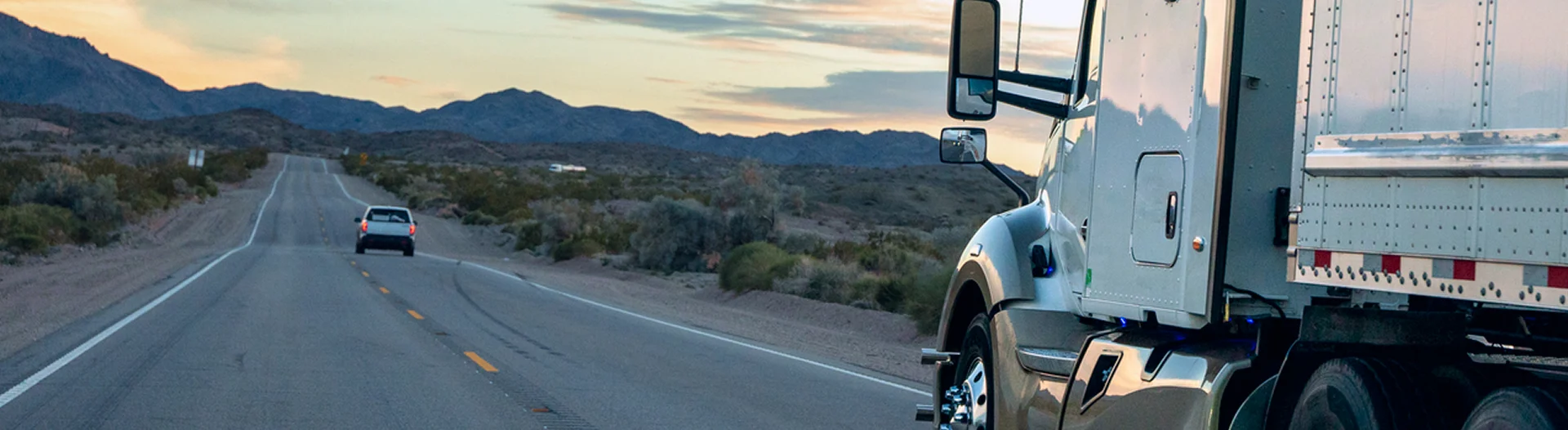
A commercial truck that cannot be seen is a commercial truck that gets hit. Inoperable marker lights, failed brake lamps, burned-out turn signals, and degraded conspicuity tape reduce a truck’s visibility to the drivers who share the road with it. The effect is worst at night, at dawn and dusk, in rain, fog, and snow, and on unlit rural highways where a truck’s lighting system may be the only thing distinguishing an 80,000-pound vehicle from the darkness around it. When a motorist strikes the side of an unlit trailer during a lane change, or rear-ends a truck whose brake lights were not functioning, the crash is not a failure of the motorist’s attention alone. It is a failure of the systems designed to make the truck visible, and a failure of the carrier that allowed the truck to operate with those systems in disrepair.
Lighting defects are among the most frequently cited violations in commercial vehicle roadside inspections. Inoperable required lamps consistently rank as one of the top vehicle violations identified during CVSA inspections.[1] These are not obscure regulatory technicalities. They are safety defects that directly reduce the ability of other drivers to see, identify, and react to a commercial motor vehicle on the road. The frequency with which they are found at inspections indicates how commonly trucks operate with degraded visibility equipment, and how many of those trucks pass through the highway system between inspections without correction.
What the Regulations Require
The federal lighting requirements for commercial motor vehicles are found in 49 C.F.R. Part 393, Subpart B, which governs lamps, reflective devices, and electrical wiring. The foundational requirement is in § 393.9(a): all lamps required by the subpart must be capable of being operated at all times.[2] This is an absolute standard. There is no exception for a lamp that works intermittently, a lamp that functions only at certain temperatures, or a lamp that the driver considers nonessential. If the regulation requires the lamp, the lamp must work.
Section 393.11 specifies the required lamps and reflective devices by vehicle type through a detailed table (Table 1) that identifies each required device, its quantity, color, location, position, mounting height, and the categories of vehicles to which the requirement applies.[3] For a standard tractor-trailer combination, the required lighting includes:
- Headlamps
- Front and rear turn signals
- Front and rear identification lamps
- Clearance lamps
- Side marker lamps (front, intermediate, and rear)
- Tail lamps
- Stop lamps
- Backup lamps
- A license plate lamp
- Reflex reflectors
- Vehicular hazard warning signal flasher lamps
All commercial motor vehicles manufactured on or after December 25, 1968, must meet the applicable requirements of FMVSS No. 108 (49 C.F.R. § 571.108) in effect at the time of manufacture.
Section 393.9(b) adds a practical requirement: lamps and reflective devices must not be obscured by the tailboard, by any part of the load or its covering, by dirt, or by other added vehicle or work equipment.[1] A lamp that functions electrically but is covered in road grime thick enough to block its light output is not compliant.
Conspicuity Tape: The Side-Visibility Problem
The retroreflective conspicuity system required on trailers addresses a specific and historically lethal crash configuration: motorists striking the side of a trailer at night because they could not see it. Before conspicuity tape was mandated, trailers were effectively invisible from the side in dark conditions. The small amber and red side marker lamps required by earlier standards were often too dim, too dirty, or too few to outline the trailer’s full length. Motorists approaching at an angle or in adjacent lanes could not detect the trailer’s presence until it was too late to avoid a collision.
Under 49 C.F.R. § 393.11(b), each trailer with an overall width of 80 inches or more and a GVWR over 10,000 pounds, manufactured on or after December 1, 1993, must be equipped with a retroreflective conspicuity system meeting the requirements of FMVSS No. 108.[2] The system must use retroreflective sheeting certified as DOT-C2 (50 mm wide), DOT-C3 (75 mm wide), or DOT-C4 (100 mm wide), or reflex reflectors, or a combination of both. The conspicuity treatment must be applied to both sides and the rear of the trailer in specific configurations: alternating red and white segments on the sides covering at least half the trailer’s length, a full-width strip across the lower rear, and white strips at the upper rear corners to outline the trailer’s dimensions.
Trailers manufactured before December 1, 1993, are subject to a separate retrofit requirement under 49 C.F.R. § 393.13, which requires motor carriers to install retroreflective tape or reflex reflectors on older trailers that meet the width and weight thresholds.[1] Truck tractors manufactured on or after July 1, 1997, must also be equipped with retroreflective material on the rear mudflap area and upper cab corners.[2]
Conspicuity tape degrades over time. Exposure to ultraviolet light, road chemicals, abrasion from road debris, and weather cycling cause the retroreflective material to lose its ability to return light to approaching drivers. Tape that has yellowed, delaminated, cracked, or lost its DOT-C2 certification markings no longer performs to standard. Missing sections of tape, whether torn off by contact with loading dock equipment, removed during trailer repairs and never replaced, or simply deteriorated beyond function, leave gaps in the trailer’s side visibility that recreate the exact hazard the conspicuity requirement was designed to eliminate.
CVSA Out-of-Service Criteria for Lighting
The Commercial Vehicle Safety Alliance’s North American Standard Out-of-Service Criteria define when lighting defects are severe enough to remove a vehicle from service.[3] For lighting devices, the CVSA criteria identify specific conditions that constitute an out-of-service violation. Inoperable or missing required lamps, including stop lamps, tail lamps, turn signals, and headlamps, are out-of-service conditions.
The CVSA criteria also address conspicuity markings. Missing or deteriorated conspicuity treatments are evaluated as part of the van and open-top trailer body inspection, and missing reflective tape is a citable violation under the applicable FMCSA regulations.[4]
The significance of the CVSA criteria in litigation is that they establish a recognized, industry-wide standard for when a lighting defect is too dangerous to allow continued operation. A truck that was operating with a defect meeting the out-of-service threshold was, by the enforcement community’s own standard, too dangerous to be on the road. If that truck was involved in a crash related to the defect, the carrier’s decision to operate the vehicle in that condition is difficult to defend.
How Lighting Systems Fail
Lighting failures on commercial trucks are not random. They follow predictable patterns rooted in the operating environment.
Corrosion at electrical connectors
Corrosion is the most pervasive cause. The electrical connectors between the tractor and trailer—the seven-pin plug and socket that carries power and signal for all trailer lighting—are exposed to road spray, salt, moisture, and physical impact every time the tractor connects and disconnects. Corroded pins and sockets create intermittent or complete loss of electrical contact. A trailer whose lights functioned when connected to one tractor may fail when connected to another because of a different pattern of pin corrosion. The junction between the tractor’s wiring harness and the trailer’s lighting circuit is the single most common failure point in the system.
Vibration-related failures
Vibration-related failures account for a significant share of bulb and LED failures. The constant vibration transmitted through the chassis and frame during highway operation causes filament bulbs to fail prematurely and can loosen LED lamp connections. Marker lamps and clearance lamps, which are mounted on the exterior of the trailer and directly exposed to vibration and impacts, fail at higher rates than lamps mounted in more protected positions.
Wire damage
Wire damage is a progressive failure mode. Wiring routed along the underside of the trailer is exposed to road debris impact, abrasion against frame members, and damage from improperly secured cargo or loading equipment. A single nick in the wire insulation can create a short circuit that disables an entire lighting circuit. Wiring that has been repaired with temporary splices rather than proper weatherproof connections is prone to re-failure as the splice corrodes.
Damage from loading operations
Damage from loading operations contributes to lighting failures on trailers. Dock equipment, forklifts, and yard jockeys can contact and break marker lamps, tear conspicuity tape, and damage wiring connections. This damage often occurs at the rear and sides of the trailer, affecting the very lamps and reflective treatments that other motorists rely on to see the trailer.
What Investigators Look For
When a crash involves a truck or trailer that may have had lighting defects, the investigation begins with documenting the condition of every required lamp and reflective device at the crash scene. Photographs should capture each lamp individually, showing whether it is intact, broken, operable, or missing. The condition of conspicuity tape should be documented along the full length of both sides and the rear of the trailer, noting missing sections, degraded areas, and sections obscured by dirt or damage.
The truck’s most recent driver vehicle inspection report under 49 C.F.R. § 396.11 should be obtained to determine whether the driver noted any lighting defects before the trip.[1] The annual periodicinspection report under § 396.17 establishes what a qualified inspector found at the most recent annual inspection.[1] The carrier’s maintenance records under § 396.3 should show whether lighting repairs were performed, how frequently, and whether the same lamps or circuits required repeated repair.[2]
The CVSA roadside inspection history for the truck and trailer, available through the carrier’s Pre-Employment Screening Program record or directly from FMCSA databases, reveals whether the vehicle had been cited for lighting violations in prior inspections. A pattern of repeated lighting citations on the same vehicle establishes that the carrier was on notice that the vehicle had a recurring lighting problem and either failed to repair it permanently or failed to maintain the repair.
Liability When Lighting Defects Contribute to a Crash
The carrier’s liability for operating a vehicle with lighting defects rests on the same regulatory framework that governs all vehicle maintenance obligations. Under 49 C.F.R. § 396.3, the carrier must systematically inspect, repair, and maintain all motor vehicles subject to its control, and all parts and accessories must be in safe and proper operating condition at all times.[3] Under § 396.7, no carrier may operate a vehicle likely to cause an accident or breakdown.[4]
A carrier that dispatches a truck or trailer with inoperable stop lamps has violated both provisions. A carrier whose trailer has been operating for months with half its conspicuity tape missing or degraded has allowed a visibility hazard to persist across hundreds of trips. The violation is not a one-time oversight—it is a continuing condition that the carrier had the ability and the obligation to correct.
The driver bears a share of the responsibility through the pre-trip inspection requirement. Under § 396.13, the driver must be satisfied that the vehicle is in safe operating condition before driving it.[5] A driver who conducts a pre-trip inspection and fails to note inoperable marker lamps, failed turn signals, or missing conspicuity tape has not performed an adequate inspection. However, the carrier’s obligation is independent of the driver’s. The carrier must have a systematic maintenance program that identifies and corrects lighting defects between inspections, not a system that relies entirely on the driver to catch every defect during a walk-around.
When the crash involves a nighttime sideswipe or rear-end collision with a trailer whose lighting or conspicuity system was deficient, the defect becomes a causation question: would the other driver have seen the trailer and avoided the collision if the lighting and reflective systems had been functioning as required? The answer depends on crash reconstruction analysis, but the regulatory framework establishes the baseline. The lighting and conspicuity systems exist because federal regulatorsdetermined they are necessary for other drivers to see the vehicle. If they were not functioning, the regulatory purpose was defeated, and the carrier must explain why.
The Carrier’s Maintenance Obligation
Lighting defects are maintenance failures, and maintenance is the carrier’s responsibility. Under 49 C.F.R. § 396.3, every motor carrier must systematically inspect, repair, and maintain all motor vehicles subject to its control.[1] The word “systematically” is not decorative. FMCSA has interpreted it to mean a regular, scheduled program designed to keep vehicles in safe operating condition, not a reactive approach that waits for a driver to report a problem or an inspector to find one. A carrier whose maintenance program does not include routine inspection of lighting circuits, lamp function checks, connector cleaning, and conspicuity tape condition has not established the systematic program the regulation requires.
The maintenance records required under § 396.3(b) must include a record of inspection, repairs, and maintenance indicating their date and nature.[2] For lighting systems, these records should document when lamps were replaced, when wiring repairs were performed, when connectors were serviced, and when conspicuity tape was inspected or replaced. A carrier that cannot produce lighting-specific maintenance records for a trailer that has been in service for years has either not performed lighting maintenance or not documented it. Either failure violates the regulation.
The carrier’s obligation extends to trailers it does not own. Many carriers operate trailers leased from trailer pools, intermodal equipment providers, or other carriers. Under 49 C.F.R. § 396.3, the maintenance obligation attaches to every motor vehicle “subject to its control,” not only vehicles the carrier owns. A carrier that accepts a leased trailer with inoperable marker lamps and dispatches it without repair has assumed the maintenance obligation and failed to meet it. The intermodal equipment provider bears its own obligations under § 396.3 and § 396.12 for equipment it tenders to motor carriers, but the carrier that puts the trailer on the road is independently responsible for the vehicle’s condition.[3]
The Role of Lighting Evidence in Crash Reconstruction
In nighttime or reduced-visibility crashes, the condition of the truck’s lighting system is often the pivotal factual issue. Crash reconstruction experts analyze the visibility question by calculating the detection distance that the truck’s lighting and conspicuity system should have provided to an approaching driver under the conditions that existed at the time of the crash. This analysis considers the ambient lighting conditions, the road geometry, the approaching vehicle’s headlamp performance, the retroreflective performance of the conspicuity tape (if functioning), and the brightness and visibility of the truck’s active lamps.
A properly functioning conspicuity system on a trailer materially improves the distance at which an approaching driver can detect the trailer under typical nighttime conditions, providing additional reaction time at highway speeds.[1] If the conspicuity tape was missing or degraded to the point of non-reflectivity, the detection distance may drop to the range at which the approaching driver can see the trailer only by its active lamps or by the shadow it creates against background lighting. In rural areas with no background lighting, a trailer with no functioning side marker lamps and no effective conspicuity tape may be virtually undetectable until the approaching driver is within a few hundred feet or less, leaving insufficient time to brake or maneuver.
The analysis also considers whether the specific lighting defect was related to the crash mechanism. A failed left-side marker lamp may not be relevant to a rear-end collision, but missing rear conspicuity tape and inoperable tail lamps are directly relevant. A burned-out right turn signal is irrelevant to a left-turn crash but central to a right-turn crash where a following driver did not receive warning of the truck’s intended maneuver. The specificity of the defect-to-crash relationship determines the strength of the causation argument.
What Discovery Should Target
Discovery in a lighting defect case should capture the vehicle’s maintenance history, the carrier’s maintenance program, and the condition of the lighting system at the time of the crash. Key categories include:
- The trailer’s complete maintenance and inspection records under § 396.3, including all lighting-related repairs, lamp replacements, wiring work, and conspicuity tape installations
- All DVIRs for the truck and trailer covering the 90 days before the crash, with attention to any lighting defects noted and whether repairs were documented
- The annual periodic inspection reports for both the tractor and trailer under § 396.17
- The CVSA roadside inspection history for the truck and trailer from FMCSA databases, documenting any prior lighting citations
- Photographs and scene documentation from the crash, including the condition of every lamp, reflector, and conspicuity treatment on the vehicle
- The carrier’s written maintenance policies and procedures, including any scheduled intervals for lighting inspection, connector maintenance, and conspicuity tape replacement
- If the trailer was leased or provided by an intermodal equipment provider, the interchange agreement and any pre-tender inspection records under § 396.12