
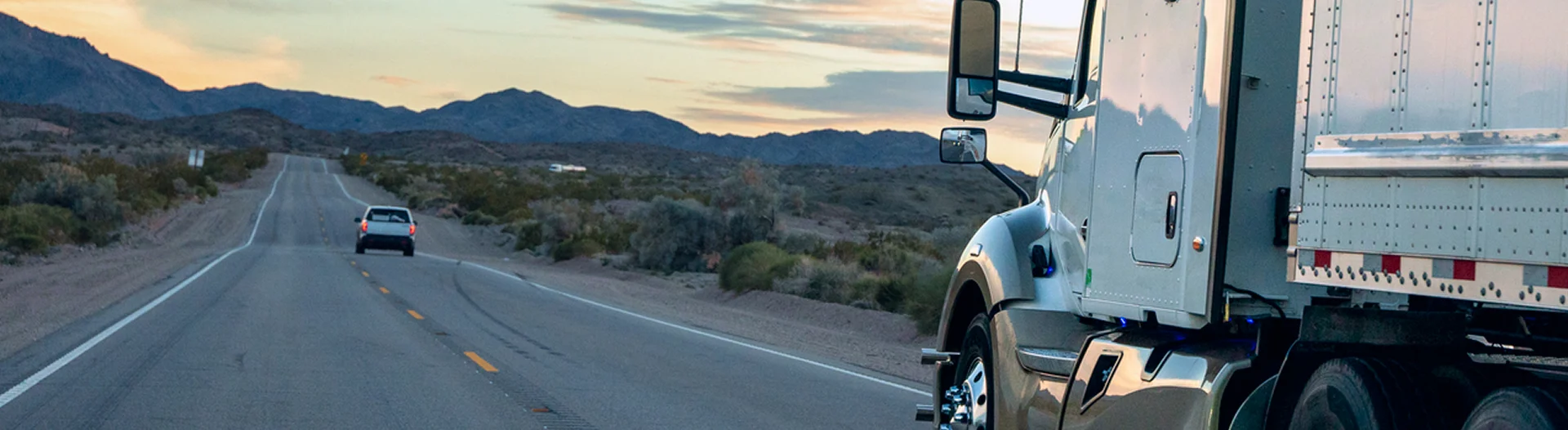
An oversize or overweight load moving on a public highway is, by definition, a vehicle that exceeds the dimensions the road was designed to accommodate. It is wider than a standard lane, taller than many overpasses, longer than most turning radii, and heavier than many bridges are rated to bear. The transportation permits that authorize these movements recognize the hazard by imposing conditions that do not apply to standard commercial vehicles: restricted routes, limited travel hours, mandatory warning signs and lights, and the requirement for one or more pilot cars, also called escort vehicles, to travel ahead of or behind the load to warn approaching traffic, flag the load through intersections, verify overhead clearances, and guide the truck through tight spots where the load's dimensions create conflicts with roadway geometry.[1]
When the pilot car fails to perform these functions, the consequences are predictable and severe. Oncoming traffic can strike the load because no one warned drivers that the lane was partially blocked. A truck can strike a low bridge because the lead escort did not verify the overhead clearance with a height pole. A load can be routed onto a road that cannot accommodate its width, causing the truck to strike a guardrail, a utility pole, or a vehicle in the adjacent lane. Or a truck can enter a weight-restricted bridge because the escort did not survey the route for load restrictions. In each of these scenarios, the pilot car operator's negligence is an independent, proximate cause of the crash, and the pilot car company bears liability separate from the trucking company and the carrier.
Pilot car negligence is not necessarily a derivative claim. Under the Restatement (Second) of Torts § 324A, one who undertakes to render services to another that are necessary for the protection of a third person can be liable for physical harm resulting from a failure to exercise reasonable care in performing the undertaking, where that failure increases the risk of harm, the undertaking involves a duty the other party owed to the third person, or the harm results from reliance on the undertaking.[2] Applying this doctrine to a pilot car's escort functions is a reasoned extension of general undertaking principles rather than a body of settled, escort-specific case law—no reported decisions squarely applying § 324A to a pilot-car fact pattern were identified—but the underlying logic is sound: the operator accepted responsibility for warning traffic, verifying clearances, and guiding the load safely through the route, and a failure to perform those functions can be a direct and independent cause of resulting injuries.
What Pilot Cars Do and Why They Matter
The pilot car's role is defined largely by the permit conditions issued by the state that authorizes the oversize load movement. Each state specifies when escort vehicles are required based on the load's width, height, length, and weight, and each state specifies how many escorts are required, where they must be positioned relative to the load, and what equipment they must carry.[3]
The Federal Highway Administration's Pilot/Escort Vehicle Operators Training Manual is a widely used federal reference for escort operations, though FHWA itself notes that oversize-load permitting and escort rules are set overwhelmingly at the state level and vary considerably from state to state.[4] The manual identifies the core functions of the pilot car operator as warning approaching traffic of the oversize load, communicating hazards and road conditions to the truck driver, verifying overhead clearances with a height pole for sufficiently tall loads, guiding the truck through intersections and lane restrictions, and controlling traffic when the load requires use of opposing traffic lanes.
The positioning of the escort vehicle relative to the load is central to its function. A lead escort travels ahead of the load, positioned to give approaching traffic advance warning of the oversize load and to give the escort operator time to identify and communicate hazards to the truck driver; a rear escort follows the load, protecting the rear of the slow-moving load from approaching traffic that may not see the load in time to slow down.[5] For the widest loads, two or more escorts may be required, with a lead escort providing advance warning and a rear escort protecting the trailing end of the load.
The escort vehicle must be equipped with specific warning devices, though exact specifications vary by state permit. Most states require an "OVERSIZE LOAD" or "WIDE LOAD" sign mounted on the escort vehicle. FHWA guidance specifies that the escort's warning light must rotate, oscillate, or flash through 360 degrees and be visible from at least 500 feet.[6] Warning flags and two-way radio communication between the escort and the truck driver are likewise standard requirements, allowing the escort to relay real-time information about traffic, clearances, and hazards.[7]
For sufficiently tall loads, the lead escort must carry a height pole—a non-conductive measuring device that physically contacts overhead obstructions before the load reaches them. Texas, for example, requires a height pole for loads exceeding 17 feet, while FHWA's general federal guidance references a 14-foot-6-inch threshold and expressly notes that the applicable threshold varies by state.[8] The height pole verifies that the load will clear bridges, power lines, traffic signals, and other overhead structures. An escort that fails to use the height pole, or that uses it incorrectly and provides an inaccurate clearance reading, has failed in the specific function that justifies the lead escort's existence.
State Certification and Equipment Requirements
The regulatory framework for pilot car operations is almost entirely state-based. The federal government does not issue oversize load permits and does not directly regulate pilot car operations, although the FHWA training manual is a commonly referenced compendium of practices that states, carriers, and escort operators frequently follow.[9] Each state sets its own requirements for when escorts are required, how many are needed, what equipment they must carry, and whether the operator must be certified.
A number of states currently require pilot car operators to be certified, including Arizona, Colorado, Florida, Georgia, Louisiana, Minnesota, Nevada, New Mexico, New York, Oklahoma, and Virginia.[10] Certification is typically obtained by completing a training course and passing a written examination, with renewal periods and reciprocity rules that vary by state; some states recognize certifications issued by other states, while others require certification specific to that state.[11]
Even in states that do not require certification, the pilot car operator is held to the standard of care that a reasonable escort operator would exercise under the same circumstances. Federal guidance materials, state permit conditions, and the industry's own common practices help establish the standard against which the operator's conduct is measured, regardless of whether the state requires formal certification.[12]
The equipment requirements are similarly state-specific but converge on a common set of minimum standards. Most states require the escort vehicle to carry oversize load signs, a rotating or flashing warning light, warning flags, two-way radios, a height pole for sufficiently tall loads, reflective triangles or emergency flares, and a stop/slow paddle for traffic control.[13] Texas, for example, requires escort vehicles to weigh between 1,000 and 10,000 pounds, carry two flashing amber lights or one rotating amber beacon at least eight inches in diameter (or alternating/flashing blue and amber lights), display an "OVERSIZE LOAD" sign of specified dimensions, maintain two-way radio communication with the permitted vehicle, and carry a height pole for loads exceeding 17 feet.[14]
How Pilot Car Negligence Causes Crashes
Pilot car failures follow identifiable patterns, each corresponding to a specific function the escort was supposed to perform.
Failure to warn approaching traffic is among the most dangerous categories. The lead escort's primary function is to alert oncoming and intersecting traffic that an oversize load is approaching. When the lead escort is too close to the load, too far ahead, not displaying warning signs or lights, or not positioned in the correct lane, approaching traffic does not receive adequate warning. A vehicle that encounters a load occupying part of the opposing lane without advance warning from the escort may have no time to stop or move to the shoulder. The crash is the direct result of the escort's failure to provide the warning the permit conditions required.
Failure to verify overhead clearances produces bridge strikes and power line contacts. When a load exceeds standard clearance heights, the lead escort must physically verify each overhead obstruction using the height pole before the load reaches it. An escort that drives under a bridge without deploying the height pole, or that deploys the pole but misreads the clearance, allows the load to strike a structure that would have been identified and avoided if the escort had performed its function. Bridge strikes can cause structural damage to the bridge, catastrophic damage to the load and truck, and injuries to the truck driver, escort operator, and any motorists on or under the bridge at the time of the strike.
Failure to guide the truck through tight spots, including narrow lanes, sharp turns, construction zones, and intersections, can result in the load striking adjacent vehicles, guardrails, utility poles, or structures. The escort operator's role in these situations is to communicate clearance information to the truck driver in real time, stop traffic when necessary, and position the escort vehicle to protect the load's path of travel. An escort that fails to communicate a tight clearance, or that positions itself in a way that blocks the truck driver's view of the hazard, has created the conditions for the crash rather than preventing it.
Failure to enforce route compliance occurs when the escort leads the truck onto a road that the permit does not authorize, or onto a bridge with a weight restriction that the load exceeds, or into a construction zone with lane widths that cannot accommodate the load. The escort operator is expected to know the permitted route and to verify that the route is clear before the load proceeds. An escort that deviates from the permitted route because of a navigation error, a shortcut attempt, or a failure to survey the route in advance has placed the load on a road that was not evaluated for the load's dimensions.
The Pilot Car's Independent Liability
The pilot car company's liability is independent of the trucking company's liability. The pilot car operator is typically an independent contractor hired by the carrier or the shipper to perform specific escort functions for a specific load movement.[15] The operator's negligence is its own tort, arising from its own breach of its own duty of care, and it is not derivative of or dependent upon the truck driver's negligence.
The pilot car operator undertook to perform escort functions that are necessary for the protection of the motoring public. When the operator fails to exercise reasonable care in performing those functions and a crash results, the operator can be liable under Restatement § 324A regardless of whether the truck driver was also negligent.[16]
The pilot car company's professional liability insurance—typically an errors-and-omissions policy covering negligence in the performance of escort services—is the coverage most likely to respond to these claims. General liability policies typically exclude professional services, which is why professional liability coverage is an important, and sometimes overlooked, part of a pilot car company's insurance program.[17]
Under 49 C.F.R. § 393.87, a commercial motor vehicle transporting a load that extends beyond the vehicle's sides by more than four inches, or more than four feet beyond the rear, must mark the extremities of the load with warning flags at least 18 inches square.[18] Under 49 C.F.R. § 393.11, commercial motor vehicles must be equipped with the required lamps and reflective devices.[19] These regulations apply to the load vehicle itself, not the escort vehicle, but they establish the federal baseline for warning markings on oversize loads. The escort's function is to supplement these markings with advance notice that the regulatory markings alone cannot provide.
What Discovery Should Target
Discovery in a pilot car negligence case should capture the escort's contractual obligations, the permit conditions, the escort's actual performance, and the communications between the escort and the truck driver. Key categories include:
- The escort contract between the pilot car company and the carrier or shipper, specifying the services the escort was hired to perform and the standards the escort agreed to meet.
- The oversize load permit issued by each state along the route, specifying the number of escorts required, their positioning, the route to be followed, the travel hours permitted, and any special conditions.
- Certification and training records for the escort operator, along with the operator's driving history.
- Radio communications between the escort operator and the truck driver during the trip, including any communications about clearances, hazards, traffic conditions, or route changes.
- GPS and telematics data from both the escort vehicle and the truck, showing the positioning of each vehicle relative to the other and to the point of the crash.
- Route survey records, if any, documenting whether the escort surveyed the route for clearances, restrictions, and hazards before the load departed.
- Insurance policies, including commercial auto, general liability, and professional liability coverage. Some states, including Georgia, require permit holders to carry substantial liability insurance (Georgia requires $1 million) as a condition of the oversize load permit, making these policies both state-mandated and directly discoverable.[20]
- Prior incidents, complaints, or claims involving the escort company's operations, which may establish a pattern of negligent performance.
The objective is to establish what functions the escort was hired and required to perform, whether the escort performed those functions, and whether the escort's failure to perform a specific function was a proximate cause of the crash.
Sources
- [1] FHWA, Pilot/Escort Vehicle Operators Training Manual, Module 2: Pilot Escort Operator and Vehicle Equipment Requirements.↩
- [2] Restatement (Second) of Torts § 324A (1965).↩
- [3] Oversize.io, Pilot Cars & Escort Vehicles: State Regulations.↩
- [4] Id. (FHWA, Pilot/Escort Vehicle Operators Training Manual).↩
- [5] Texas DMV, Escort and Equipment Requirements.↩
- [6] FHWA, Pilot/Escort Vehicle Operators Training Manual, Module 2.↩
- [7] Id. (Texas DMV, Escort and Equipment Requirements).↩
- [8] Texas DMV, Escort and Equipment Requirements (17-foot height-pole threshold); cf. FHWA, Pilot/Escort Vehicle Operators Training Manual, Module 2 (general federal guidance citing a 14-foot-6-inch threshold, noting state requirements vary).↩
- [9] FHWA, Pilot/Escort Vehicle Operators Training Manual, Module 2 (noting oversize-load permitting and escort requirements are set overwhelmingly at the state level).↩
- [10] Evergreen Safety Council, Pilot/Escort Vehicle Operator Certification.↩
- [11] Id.↩
- [12] FHWA, Pilot/Escort Vehicle Operators Training Manual, Module 2.↩
- [13] Oversize.io, Pilot Cars & Escort Vehicles: State Regulations.↩
- [14] Texas DMV, Escort and Equipment Requirements.↩
- [15] Cf. Arizona Pilot Car Service, Pilot Car Insurance (describing industry-typical professional-liability coverage for escort operators).↩
- [16] Restatement (Second) of Torts § 324A (1965).↩
- [17] Cf. Arizona Pilot Car Service, Pilot Car Insurance (describing industry-typical professional-liability coverage for escort operators).↩
- [18] 49 C.F.R. § 393.87, Marking of loads that extend beyond the sides or rear of a vehicle.↩
- [19] 49 C.F.R. § 393.11, Lamps and reflective devices.↩
- [20] Georgia DOT, PartnerSmart Oversize/Overweight Permitting (permit-holder liability insurance requirement).↩