
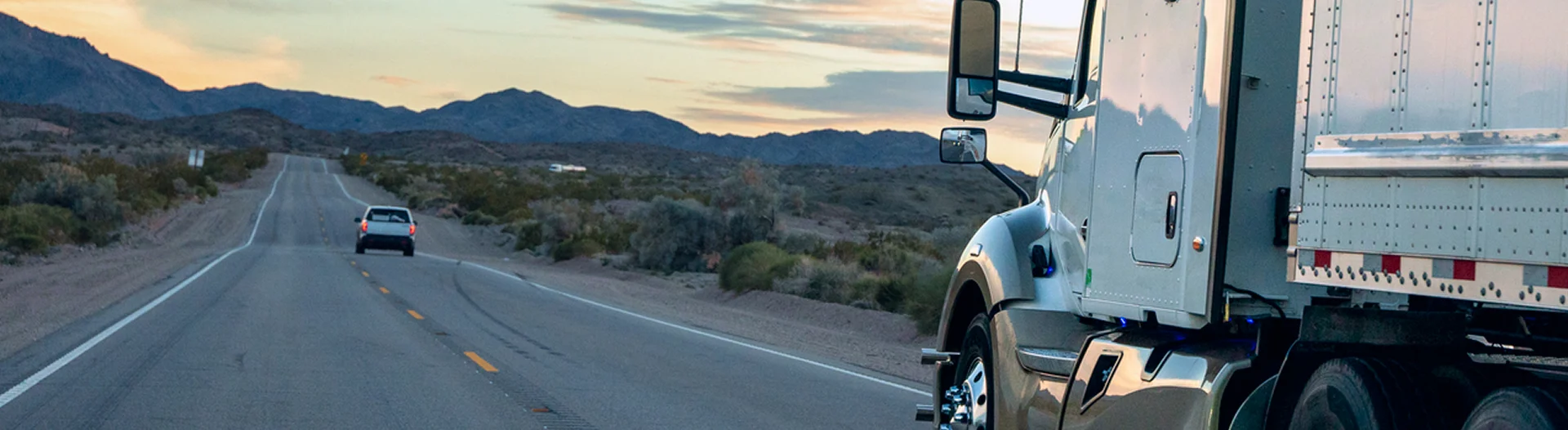
Commercial truck fires often look sudden from the road. A driver sees smoke in a mirror, smells burning rubber, notices a gauge climbing, or loses power before flames become visible. By that point, the fire may already have moved beyond the component where it started. Diesel fuel, hydraulic fluid, oil, tires, wiring insulation, plastic housings, cargo packaging, sound insulation, and road debris can turn a localized heat source into a fast-moving vehicle fire.
The scale of the problem is measurable. NFPA's 2024 vehicle-fire tables estimate that from 2018 to 2022, U.S. fire departments responded each year to 195,927 highway vehicle fires, causing 579 civilian deaths, 1,336 civilian injuries, and $2.162 billion in property damage. Large trucks accounted for an estimated 15,462 fires, 46 deaths, 102 injuries, and $416 million in property damage each year.¹
Older commercial-truck-specific research found that commercial trucks represented 3.5 percent of registered highway vehicles and 2.6 percent of all highway vehicle fires, but 17.0 percent of fatal highway fire incidents. While that statistic came from a 2003 to 2008 Volpe analysis, not a current annual estimate, it still helps explain why truck fires receive special attention. A commercial truck is larger, heavier, often carries cargo, and may involve diesel fuel, pressurized systems, high-temperature exhaust components, wheel-end heat, and longer evacuation distances for nearby traffic.²
A truck fire is almost never a random event. It is usually the final, visible stage of a maintenance, inspection, design, or operating problem. The investigation begins with the fire, but it usually moves backward to the leak, short, friction source, bearing failure, brake drag, exhaust routing issue, or prior repair that made ignition possible.
Where Truck Fires Start
The most important question after a truck fire is, where did it originate? The origin is the location where the fire began. The cause, on the other hand, refers to the event, defect, or condition that ignited the first fuel. In truck fires, those questions are difficult because the fire often destroys the components that explain why it started.
NFPA's large-truck fire data shows that fire origin is concentrated in the mechanical areas of the vehicle. In the 2018 to 2022 annual averages, large trucks had 15,462 fires. NFPA's table topics identify a specific large-truck table for area of origin, and the supporting data separates large-truck fires by location within the vehicle.³ The same NFPA file shows large-truck fires most often occur in public roadway settings. For large trucks, 11,903 fires, or 77 percent, occurred on highways, streets, or in parking areas. Highway or divided highway locations alone accounted for 7,275 fires, 35 deaths, 41 injuries, and $190 million in property damage.⁴
NFPA's vehicle-fire research summarized a recurring pattern across vehicle studies. It identified engine compartments and wheel wells as the most frequent areas of fire origin, with those areas together making up about 70 percent of reported fires in the relevant studies.⁵
Engine Compartment Fires
Engine compartments contain multiple fire sources in a confined space. Electrical cables, fuel lines, oil lines, turbocharger surfaces, exhaust components, insulation, plastic connectors, and moving parts all operate near heat. A small failure can become serious when combustible fluids contact hot surfaces or when damaged wiring creates an electrical arc.
Federal rules recognize this risk. 49 C.F.R. § 393.83 regulates exhaust systems and prohibits exhaust components from being located where they are likely to burn, char, or damage electrical wiring, the fuel supply, or any combustible part of the vehicle.⁶ This requirement means exhaust systems must be securely fastened and must not be placed where they are likely to damage wiring, fuel supply, or combustible parts.⁷ Fuel systems are regulated as well. 49 C.F.R. § 393.65 applies to systems that contain and supply fuel for motor vehicles and auxiliary equipment.⁸ Commercial-vehicle fuel systems, including tanks and lines, are subject to requirements covering location, installation, and other safety conditions under this rule.⁹
Leaks matter because heat and fuel only need to meet once. Motor carriers must systematically inspect, repair, and maintain their vehicles, and oil or grease leaks are a common repair and maintenance violation under that federal maintenance obligation.¹⁰ When oil, fuel, or grease escapes near exhaust piping, turbochargers, or other hot surfaces, the vehicle may show warning signs before flames appear.
Those signs can include:
Electrical failures create another pathway. NHTSA investigation materials involving Freightliner engine-compartment fires identified a proximate cause as an electrical fault resulting from abrasion and damage to power-cable insulation.¹¹ NHTSA engine-compartment fire investigation materials also show the kind of evidence investigators use, including cause-and-origin reports, eyewitness accounts, photographs, and physical evidence from the engine compartment.¹²
Wheel-End Fires & Brake Heat
Some of the most dangerous truck fires start far from the engine. Wheel ends create heat through braking, bearing operation, tire flex, friction, and road contact. When brakes drag or bearings fail, temperatures can rise until grease, oil, rubber, or nearby debris ignites.
The NTSB investigation of the 2005 motorcoach fire on Interstate 45 during the Hurricane Rita evacuation is one of the strongest federal sources on wheel-end fire progression. NTSB found that insufficient lubrication in the right-side tag-axle wheel bearing assembly led to increased temperatures, failed wheel bearings, ignition of the tire, and a catastrophic fire. NTSB also cited maintenance failures, pre-trip inspection failures, incomplete vehicle defect reports, and inadequate oversight.¹³ Industry fire-prevention sources describe why tire and wheel-end fires can develop quickly once temperatures climb. Heavy Duty Trucking reports that tire rubber compounds begin to break down above about 250 degrees Fahrenheit, emit flammable vapors around 500 to 550 degrees, can ignite if an ignition source is present around 650 to 700 degrees, and may spontaneously combust around 850 to 900 degrees.¹⁴
Penske cites the Technology & Maintenance Council of the American Trucking Associations for four common causes of truck fires involving brakes, wheel bearings, air leaks, and tires.¹⁵ That list tracks what investigators often see in post-fire evidence.
Common findings include:
CVSA inspection materials reinforce that these systems are inspection targets. Level II inspections include examination of brake systems, exhaust systems, fuel systems, tires, wheels, rims, and hubs.¹⁶ CVSA roadside inspection operational policies also include brake smoke or fire as a wheel-end inspection issue.¹⁷
Maintenance Records Often Explain the Fire
NFPA's data points toward maintenance as a central issue. Mechanical failure or malfunction and electrical failure or malfunction are both established factors contributing to ignition in highway vehicle fires. Leaks or breaks, worn-out components, short-circuit arcs, and damaged insulation all appear within those larger categories.¹⁸
The U.S. Fire Administration found a similar pattern across highway vehicles generally. Its report on 2014 to 2016 highway vehicle fires stated that 62 percent of highway vehicle fires and 36 percent of fatal highway vehicle fires originated in the engine, running gear, or wheel area. It also identified mechanical failure as the leading factor contributing to ignition, accounting for 45 percent of highway vehicle fires.¹⁹
Those statistics make maintenance records critical. Investigators look for repeated oil leaks, fuel-line repairs, coolant problems, electrical complaints, battery cable repairs, alternator work, starter repairs, turbocharger or exhaust repairs, brake adjustments, wheel-end service, bearing lubrication, tire failures, ABS complaints, and unresolved driver reports. A fire that appears unexplained at the scene may become clearer once the repair history shows repeated problems in the same area where the fire originated.
Driver inspection records also matter. A driver may notice warning signs before a fire develops, but those signs are easy to miss or minimize during a delivery schedule. Smoke from a wheel end can be mistaken for dust. A hot smell can be dismissed as normal brake odor after a grade. A flickering electrical fault can be treated as a nuisance. A small oil leak can be deferred until the next service interval. The question after a fire is not only what burned. It is whether earlier signs should have removed the truck from service before ignition.
Fire Extinguishers & Driver Response
Federal rules require most commercial motor vehicle power units to carry emergency equipment, including fire extinguishers. 49 C.F.R. § 393.95 requires the extinguisher to be filled, readily accessible, and securely mounted.²⁰ But a fire extinguisher requirement does not mean a driver can safely fight every fire. The proper response depends on origin, fire size, cargo, traffic, wind, fuel involvement, and evacuation risk. A small electrical smoke event in a safe pull-off area is different from a wheel-end fire on a shoulder, a diesel spill after a crash, or a trailer fire involving unknown cargo.
The driver's first responsibility is to recognize danger early. Warning signs may include:
In a developing wheel-end fire, stopping in dry grass or beside combustible roadside material can create additional spread risk. In an engine fire, opening the hood can introduce oxygen and worsen flame spread if done without a plan.
Post-fire investigation should document whether the extinguisher was present, charged, mounted, accessible, and appropriate for the vehicle. It should also determine whether the driver had fire-response training and whether the carrier had procedures for smoke, brake heat, fuel leaks, oil leaks, and electrical faults.
Why Fire Cause Is Hard to Prove
Fire often destroys its own evidence. The component that first failed may be the component most heavily burned. Wiring can melt and arc after the fire starts, making it difficult to distinguish cause from damage. Fuel lines can burn away. Plastic reservoirs can disappear. Brake and wheel-end evidence can be altered by firefighting water, towing, salvage handling, and post-fire dismantling.
NFPA 921 is the accepted guide for fire and explosion investigations. The NFPA page identifies it as the guide for investigators analyzing fire and explosion origin and cause.²¹ USFA training materials define fire investigation as the process of determining the origin, cause, and development of a fire or explosion and cite NFPA 921 as the methodological framework.²² Fire Engineering explains the practical problem in vehicle-fire investigations. Because combustible materials are packed into a relatively small space, a vehicle fire can become a total loss and leave few clues for determining cause. The article identifies the engine area, running gear, and wheel area as common fire origins and emphasizes that trained investigators are needed to determine origin and cause.²³
NHTSA vehicle-fire case-study materials show why detailed documentation matters. They discuss collection of collision-fire data to evaluate fire causes, propagation rates, fire paths, and injury mechanisms.²⁴ Without early photographs, component preservation, witness interviews, and maintenance records, a fire investigation may be left with competing explanations that cannot be tested.
Litigation Turns on Preservation & Reconstruction
Truck-fire litigation often begins with a burned vehicle and several possible defendants. The carrier may point to a component defect. A manufacturer may point to maintenance. A repair shop may point to driver operation. The driver may point to a condition that was never repaired. The only way to sort those theories is to preserve evidence and reconstruct the failure sequence.
MDB Trucking, LLC v. Versa Products Co. shows how preservation disputes can shape commercial trucking litigation generally. The Nevada Supreme Court addressed sanctions in a case involving alleged spoliation of trucking equipment and reversed case-ending sanctions, emphasizing the need to evaluate preservation duties, prejudice, and the appropriate remedy.²&sup5;
A complete truck-fire investigation should preserve the:
- Engine compartment
- Wiring harnesses
- Battery cables
- Alternator
- Starter
- Fuel lines
- Oil lines
- Turbocharger area
- Exhaust components
- Heat shields
- Brake assemblies
- Hubs
- Bearings
- Tires
- Wheel seals
- Cargo remnants
- Electronic modules
- Event data
- Dashcam footage
- Maintenance records
- DVIRs
- Roadside inspection history
- Repair orders
- Fire-scene photographs
It should also collect fire marshal records, private origin-and-cause reports, insurance photographs, towing records, and witness statements.
The central question is not simply where flames were first seen. Flames may be visible in a different area than the point of origin. A wheel-end fire can spread to tires and trailer decking. An engine fire can spread through wiring and insulation. A crash fire can follow fuel release and ignition after impact. A post-fire electrical arc may look like an initiating short unless the investigator separates cause from fire damage.
Commercial truck fires are preventable in many cases, but only if warning signs are treated as safety signals rather than downtime. Smoke, odor, heat, leaks, dragging brakes, hub temperature, electrical faults, and recurring repairs are not background noise. They are the evidence trail before ignition. Once the vehicle burns, that trail becomes harder to read, which is why early preservation and disciplined forensic work often determine whether the cause can be proven.
Sources
- [1] National Fire Protection Association, "Vehicle Fires" (supporting data tables), November 2024.
- [2] Pearlman, Jonathan, and Neil R. Meltzer, "Risk of Commercial Truck Fires in the United States: An Exploratory Data Analysis," John A. Volpe National Transportation Systems Center, prepared for the Federal Motor Carrier Safety Administration, June 29, 2012.
- [3] National Fire Protection Association, "Vehicle Fires" (supporting data tables, large-truck area-of-origin table), November 2024.
- [4] Id.
- [5] Ahrens, Marty, "U.S. Vehicle Fire Trends and Patterns," National Fire Protection Association, June 2010.
- [6] 49 C.F.R. § 393.83, eCFR, current as of July 2026.
- [7] Id.
- [8] 49 C.F.R. § 393.65, eCFR, current as of July 2026.
- [9] Id.
- [10] 49 C.F.R. § 396.3, eCFR, current as of July 2026.
- [11] National Highway Traffic Safety Administration, Office of Defects Investigation, Engineering Analysis EA04-008 (Freightliner), Investigation Report.
- [12] National Highway Traffic Safety Administration, Office of Defects Investigation, Engineering Analysis EA05-005, Investigation Report.
- [13] National Transportation Safety Board, Highway Accident Report NTSB/HAR-07/01, Motorcoach Fire on Interstate 45 During Hurricane Rita Evacuation Near Wilmer, Texas, September 23, 2005, February 21, 2007.
- [14] Heavy Duty Trucking, "How to Prevent Wheel-End Fires".
- [15] Penske Truck Leasing, "Truck Fires" (resource library, citing the Technology & Maintenance Council of the American Trucking Associations).
- [16] Commercial Vehicle Safety Alliance, "All Inspection Levels".
- [17] Commercial Vehicle Safety Alliance, Roadside Inspection Operational Policies.
- [18] National Fire Protection Association, "Vehicle Fires" (supporting data tables, factor contributing to ignition), November 2024.
- [19] U.S. Fire Administration, Topical Fire Report Series, "Highway Vehicle Fires (2014-2016)," Vol. 19, Issue 2.
- [20] 49 C.F.R. § 393.95, eCFR, current as of July 2026.
- [21] National Fire Protection Association, NFPA 921: Guide for Fire and Explosion Investigations, 2021 ed..
- [22] U.S. Fire Administration, National Fire Academy training materials, SM 0770.
- [23] Fire Engineering, "Investigating Vehicle Fires".
- [24] National Highway Traffic Safety Administration vehicle-fire case-study materials, Motor Vehicle Fire Research Institute Library.
- [25] MDB Trucking, LLC v. Versa Prods. Co., Inc., 475 P.3d 397 (Nev. 2020).