
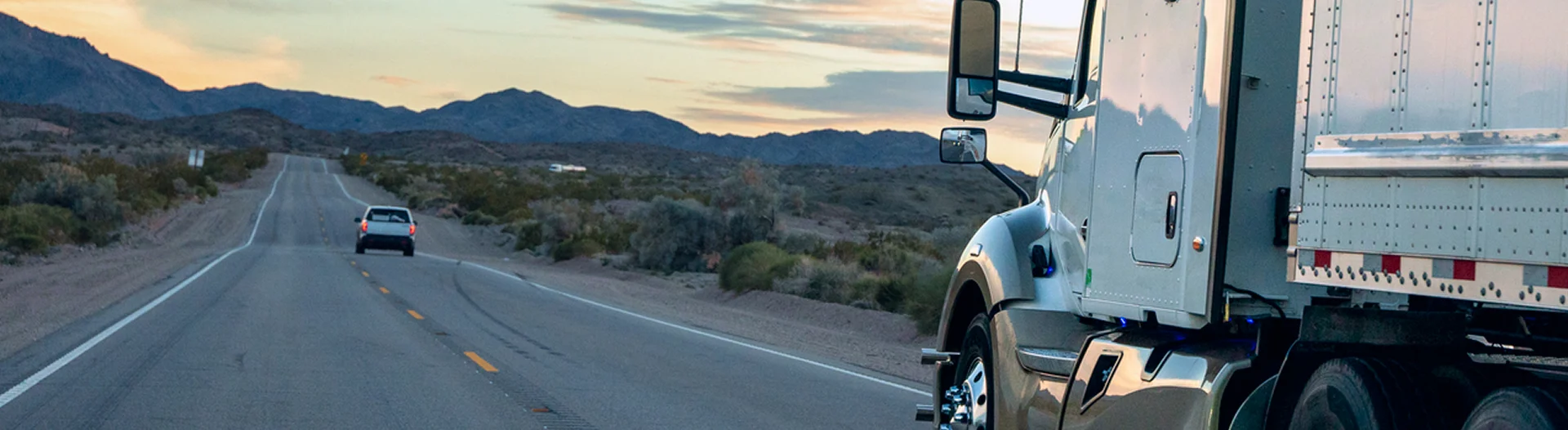
A glider kit truck looks, from the outside, like any other commercial semi. The cab is new, the frame is new, and the interior is modern. But beneath the hood is an engine pulled from an older vehicle, remanufactured, and installed into a body it was never originally designed to power.
What Is a Glider Kit?
According to the EPA and NHTSA, the term “glider kit” refers to a chassis and cab assembly produced by a vehicle manufacturer without a new engine, transmission, or rear axle. To make the vehicle functional, a third party then typically installs a used engine, transmission, and/or rear axle to complete assembly of the vehicle. The completed vehicle is called a “glider vehicle.” Under 40 C.F.R. § 1037.801, a glider vehicle is formally defined as “a new motor vehicle produced from a glider kit, or otherwise produced as a new motor vehicle with a used/remanufactured engine.”1
Engines installed in glider kits are often salvaged from earlier model year vehicles, remanufactured, and installed in the new chassis.
“Four Original Equipment Manufacturers (OEMs) currently produce glider kits in the United States:
- Peterbilt
- Kenworth
- Freightliner
- Western Star”2
“Numerous companies unassociated with the OEMs serve as the final manufacturers or assemblers of the completed vehicles.”2 “The final manufacturer of the glider vehicle (i.e. the entity that assembles the parts) is typically a different entity than the original manufacturer of the glider kit.”2
The Emissions Loophole
The key regulatory distinction lies in the model year of the installed engine. The EPA passed major sets of environmental standards in the years 2007 and 2010. Yet, by “using engines from the 1990s and early 2000s, the glider kit industry found a way to skirt these more stringent standards.”3 In particular, using a pre-emission engine in a new glider kit allows the completed vehicle to operate under the emissions certification of the engine's original model year instead of the year the new chassis was assembled.
Glider vehicles have legitimate uses. When a truck's chassis is destroyed in a crash, but the engine is intact and serviceable, a glider kit allows the reuse of a functioning powertrain rather than scrapping it entirely. But that is not why the glider market grew significantly between the mid-2000s and the mid-2010s.
“While a few hundred glider vehicles produced annually in the 2004–2006 timeframe may have been produced for arguably legitimate purposes…[the] EPA believes that the more than tenfold increase in glider kit production since the 2007 criteria pollutant emission standards took effect reflects an attempt to avoid these more stringent standards.”4
Emissions Gaps
The core regulatory concern driving federal attention to glider kits is their emissions profile. A truck that looks new and is registered as new may be emitting pollutants at levels characteristic of vehicles manufactured twenty years earlier.
EPA's National Vehicle and Fuel Emissions Laboratory conducted dynamometric emissions tests comparing selected glider vehicles with remanufactured engines originally certified between model years 1998 and 2002 against conventionally manufactured 2014 and 2015 model year tractors with engines compliant with 2010 standards.
The study found that:5
A separate analysis by the California Air Resources Board further illustrated the scale of the disparity: glider vehicle NOx levels were 4 to 40 times higher, and PM levels were 50 to 450 times higher than emissions from modern vehicles that meet today's standards.6 These vehicles lack the diesel particulate filters that trap toxic soot and the selective catalytic reduction systems that limit smog-forming nitrogen oxide,6 both of which have been mandatory on new trucks since 2010.
The emissions gap has been the primary driver of federal regulatory action on glider kits. EPA's Phase 2 greenhouse gas and fuel efficiency standards, finalized in 2016, treated glider vehicles as new vehicles subject to current emissions requirements and capped production of non-compliant glider vehicles at 300 units per year for small manufacturers, to be effective in January 2018.7 However, in November 2017, the EPA proposed to repeal the glider-specific portions of the Phase 2 rule,8 and the agency exercised enforcement discretion to decline enforcement of the 300-unit production cap in 2018 and 2019.9 The proposed repeal was never finalized. The Phase 2 glider provisions remain technically in effect, though enforcement history has been inconsistent across administrations.
What has not shifted is the physical reality: a glider vehicle with a pre-2007 engine emits far more pollution than a modern truck, regardless of how new its cab appears.
Safety Systems: The Integration Process
Emissions aside, glider kit trucks present a different category of concern for crash investigators: the integration gap between the older engine and the modern safety systems installed in the new chassis.
Modern commercial trucks contain integrated systems in which the engine, transmission, braking systems, and active safety technologies communicate through shared electronic architecture. Anti-lock braking systems (ABS), electronic stability control (ESC), lane departure warning systems, automatic emergency braking (AEB), and collision mitigation technologies all depend on data from the engine control module and the vehicle's electronic systems to function as designed. A pre-2007 engine installed in a modern glider kit chassis may not have the ECM architecture that those safety systems expect.
“Newer chassis were often outfitted with remanufactured pre-2000 engines, in some cases without electronic control modules (ECMs) to which the ELD could effectively connect to.”10 The same ECM gap that creates the ELD exemption may also affect other systems that depend on engine-level electronic data. A safety system designed to communicate with modern ECM that is installed in a chassis whose engine lacks one may not function as designed.11
The patchwork assembly process compounds this risk. The chassis manufacturer, the engine remanufacturer, and the final assembler are three separate entities. The safety testing that applies to fully integrated vehicles from a single manufacturer does not apply in the same way to a vehicle assembled from components produced by different entities under different regulatory regimes.12 An integration defect that only manifests under specific operating conditions may never be identified before the vehicle enters service.
The ELD Exemption
One regulatory consequence of the glider kit structure has direct implications for crash investigations: the ELD exemption for pre-2000 engines. “Vehicles with engines predating model year 2000…are not required to have an ELD, even if the VIN number reported on the registration indicates that the CMV is a later model year.”13 “There may be instances when the model year reflected on the vehicle registration is not the same as the engine model year, most commonly when a vehicle is rebuilt using a 'glider kit' or when an engine is swapped from one vehicle to another.”13
The practical consequence of this exemption is that a glider vehicle with a pre-2000 engine operates under paper logs rather than electronic logging. The ELD data that has become central to hours-of-service investigations in modern crashes (i.e. GPS-stamped duty status records, engine-on and engine-off events, edit histories, unidentified driver profiles) is simply absent. The carrier may have paper records covering the same period, but those records carry none of the tamper-evidence properties of an ELD audit trail.
John Seidl, who provides DOT transportation consulting to motor carriers and Vice President of Risk Services for Reliance Partners advises that “if you're running a glider, you'd better not only have paperwork, but try to tie that pre-2000 engine to the paperwork you have.”14
This paperwork includes:14
Documentation is essential. If the registration shows that the vehicle is a 2015 Freightliner, yet the carrier claims a 1999 engine, a DOT investigator may “not accept mere paperwork.”14 Drivers need proof of their pre-2000 engines. Engine serial number documentation is the critical link between the exemption claim and its legitimacy. In fact, “49 C.F.R. Part 379, Appendix A requires motor carriers to maintain all documentation on motor and engine changes at the principal place of business.”14
Glider Kit Status in Litigation
When a crash involves a glider kit vehicle, several investigative questions become relevant that would not arise with a standard modern truck. The first is vehicle identification. The chassis VIN will reflect the year the kit was assembled. However, in the case of a glider kit truck, the engine is likely older, potentially by decades.
Identifying the vehicle accurately requires documentation of both the chassis and the engine:
- The kit manufacturer
- The engine remanufacturer
- The final assembler
- The service history of each component
Because of the nature of assembling a glider kit truck, that documentation may be scattered across multiple entities and may be incomplete.15
The second is the safety system question. When mechanical failure contributes to a crash involving a glider kit, the investigation needs to determine whether the safety system that failed was designed to integrate with the vehicle's actual engine architecture, and whether that integration was properly verified at assembly. A collision mitigation system that a carrier believed was functioning may have been operating in a degraded mode because the ECM interface was not present or was incompatible.
The third is maintenance history. Representatives of the glider assembler industry assert, and operators frequently report, that older pre-emissions engines are more reliable and fuel efficient and require less maintenance than modern emissions-equipped engines, and that they yield less vehicle downtime.16 The maintenance records for both the chassis components and the engine need to be examined separately, because they originate with different entities.
Finally, the carrier's knowledge of the glider kit's specific characteristics is relevant. A carrier that purchased a glider kit vehicle and put it into service without verifying safety system integration, without ensuring compliance with applicable emissions requirements, and without confirming the accuracy of the ELD exemption documentation has made a series of decisions about a vehicle whose regulatory status is more complex than a standard new truck.17 When a crash follows, those decisions are part of the carrier's operational record.
Sources
- [1] 40 C.F.R. § 1037.801, "Definitions,".
- [2] Congressional Research Service, Glider Kit, Engine, and Vehicle Regulations, R45286 (Sept. 10, 2018).
- [3] Environmental and Energy Study Institute, "'Super Polluting' Glider Trucks Debate Marked by EPA Vacillation, Semantic Disputes" (Oct. 16, 2018).
- [4] U.S. Environmental Protection Agency, "Greenhouse Gas Emissions and Fuel Efficiency Standards for Medium- and Heavy-Duty Engines and Vehicles—Phase 2," 81 Fed. Reg. 73478, 73943 (Oct. 25, 2016), as quoted in Congressional Research Service, Glider Kit, Engine, and Vehicle Regulations, R45286 (Sept. 10, 2018).
- [5] EPA National Vehicle and Fuel Emissions Laboratory, "Chassis Dynamometer Testing of Two Recent Model Year Heavy-Duty On-Highway Diesel Glider Vehicles" (Nov. 20, 2017), Docket No. EPA-HQ-OAR-2014-0827-2417.
- [6] California Air Resources Board, Testimony of Steve Cliff, Deputy Executive Officer, Public Hearing on Repeal of Emission Requirements for Glider Vehicles, Glider Engines, and Glider Kits (Dec. 4, 2017).
- [7] Congressional Research Service, Glider Kit, Engine, and Vehicle Regulations, R45286 (Sept. 10, 2018) (discussing U.S. EPA & NHTSA, "Greenhouse Gas Emissions and Fuel Efficiency Standards for Medium- and Heavy-Duty Engines and Vehicles—Phase 2," 81 Fed. Reg. 73478 (Oct. 25, 2016)).
- [8] U.S. EPA, "Repeal of Emission Requirements for Glider Vehicles, Glider Engines, and Glider Kits," 82 Fed. Reg. 53442 (Nov. 16, 2017).
- [9] Overdrive Staff, "EPA Won't Enforce Glider Emissions Limits Until End of 2019," Overdrive.
- [10] Overdrive Staff, "FMCSA Considering Changing ELD Regs Around Glider Kits, Pre-2000 Engines, More," Overdrive (Sept. 15, 2022).
- [11] Federal Motor Carrier Safety Administration, "ELD Rule FAQs" (Sept. 2018).
- [12] Congressional Research Service, Glider Kit, Engine, and Vehicle Regulations, R45286 (Sept. 10, 2018).
- [13] Federal Motor Carrier Safety Administration, "When does the pre-2000 model year exception apply?" ELD Guidance (effective Sept. 19, 2018).
- [14] Deborah Lockridge, "Running Pre-2000 Engines, Paper Logs Calls for Right Documentation," Heavy Duty Trucking (Feb. 24, 2020).
- [15] 40 C.F.R. § 1037.620, "Responsibilities for Multiple Manufacturers,".
- [16] Congressional Research Service, Glider Kit, Engine, and Vehicle Regulations, R45286 (Sept. 10, 2018).
- [17] 40 C.F.R. § 1037.635, "Glider Kits and Glider Vehicles,".