
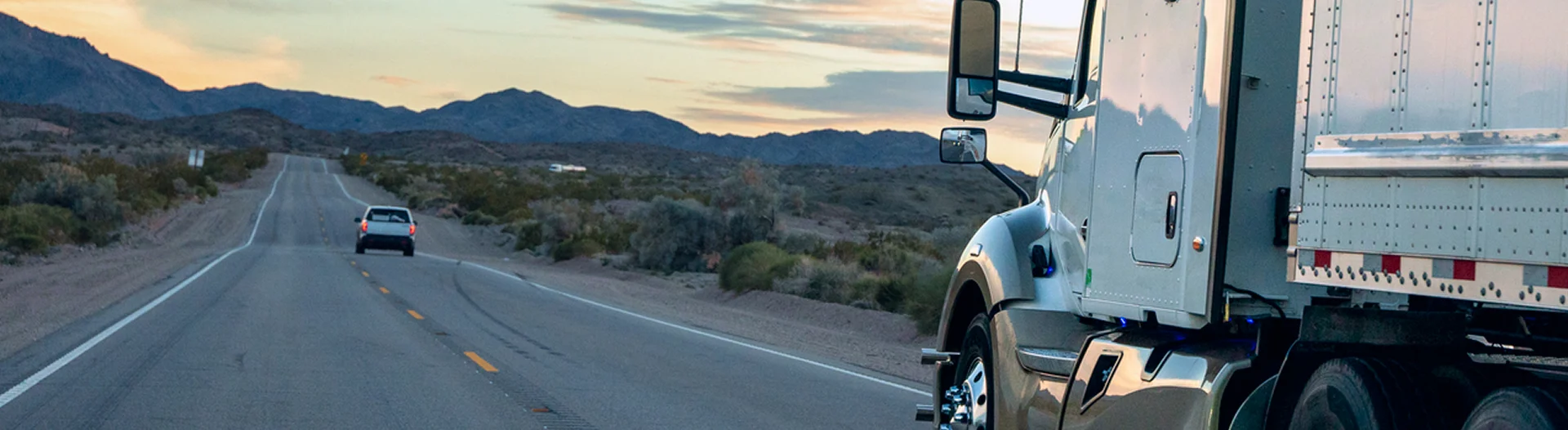
Air brake systems allow commercial trucks to slow and stop vehicles that can weigh up to 80,000 pounds.
Unlike passenger vehicles that rely on hydraulic braking systems, heavy trucks use compressed air to move braking force from the driver’s pedal to brake chambers at the wheel ends. That design gives commercial vehicles the braking force needed for heavy loads, but it also creates failure points that do not exist in ordinary passenger vehicles.
A truck’s brakes do not fail only when every brake stops working. Air brake failure often develops in stages. A leaking hose may reduce pressure reserve. A damaged fitting may make the compressor cycle more often. A trailer-supply defect may impair braking force at the trailer even while the tractor still has service braking. A tractor-protection valve may fail to preserve air for a controlled stop after a trailer-line failure. These conditions matter because commercial trucks need not only braking force, but balanced, repeatable braking force across multiple axles.
Federal rules recognize that air brake systems depend on mechanical integrity and pressure retention. The Federal Motor Carrier Safety Regulations require service brakes, parking brakes, emergency braking systems, brake tubing, brake hoses, reservoirs, warning devices, and related components to meet performance and condition requirements.1
Air Brakes Depend on Stored Pressure & Redundant Circuits
Air brakes work by storing compressed air in reservoirs and delivering that air to brake chambers when the driver applies the brake pedal. The brake chamber converts air pressure into mechanical movement that applies the foundation brake at the wheel end. Commercial driver training materials explain that air systems use reservoirs because every brake application consumes some of the stored air supply.2
Most heavy trucks use dual air systems. The purpose is redundancy. If one circuit loses pressure, the second circuit may preserve partial braking capability long enough for the driver to stop. But redundancy should not be confused with normal braking performance. A truck with one weakened circuit may still move down the road while already operating with reduced stopping margin.3 Spring brakes add another layer of protection, but they are not a substitute for a healthy service-brake system. Spring brakes are held off by air pressure and apply when air pressure drops too low. CDL materials warn drivers not to wait for automatic spring-brake application and instruct them to stop immediately when low-air warnings activate.4
That warning reflects the practical danger of pressure loss. A loaded combination vehicle traveling at highway speed needs controlled service braking. Sudden or partial spring-brake application may be harsh, uneven, and dependent on the condition of the same foundation brakes that may already be worn, out of adjustment, or contaminated. In reconstruction terms, the question is rarely just whether "the brakes worked."
The better question is whether the system maintained enough pressure, balance, reserve, and trailer response for the driver to stop safely before the crash sequence developed.
Federal Inspection Rules Treat Brake Integrity as a Continuous Duty
Federal regulations require motor carriers to inspect, repair, and maintain commercial motor vehicles so that all parts and accessories remain in safe and proper operating condition. Under 49 C.F.R. Part 396, carriers must systematically inspect, repair, and maintain vehicles under their control.5 Those inspection obligations matter because air brake problems often develop gradually.
Federal hose rules are especially important in air brake cases. Section 393.45 requires brake tubing and hose to be properly attached, leak-free, and free from chafing, kinking, constriction, heat damage, and other conditions that could cause failure.6
The reason is simple. The system only works if it can hold air while the truck is moving, vibrating, turning, coupling, uncoupling, and operating in rain, heat, debris, and road grime. A small leak may not immediately disable the vehicle. The compressor may temporarily compensate. But each brake application consumes stored air. In traffic, on grades, or during repeated braking, demand can exceed recovery.
At that point, a hidden leak becomes a stopping-distance problem.
Crash-Causation Data Shows Brake Defects in Serious Truck Crashes
The Federal Motor Carrier Safety Administration’s Large Truck Crash Causation Study remains one of the strongest national sources for examining mechanical defects in serious truck crashes. FMCSA’s LTCCS analysis brief uses Michigan State Police FACT data (1996–2001) as an illustrative example of the kind of inspection-based analysis LTCCS supports.
That FACT dataset reported pre-crash inspection violations across 407 inspected large trucks.7
The most important comparison in that same analysis concerns braking-critical crashes. FMCSA reported that trucks involved in crashes where braking capability influenced the crash sequence were about 50% more likely to have brake violations than trucks involved in crashes where braking was not considered critical.8 The Crash Weighting Report explains why LTCCS findings can be used beyond a small set of individual files. FMCSA used weighting procedures so the crash data would reflect national crash-involvement patterns rather than only localized sampling effects.9
Those numbers do not mean every crash with a brake violation was caused by that violation. They do show that brake-system defects are common enough in serious truck crashes to require careful analysis. When a crash involves rear-end impact, emergency braking, downhill travel, stopped traffic, or failure to slow, pressure integrity, hose condition, adjustment, and air-system recovery become central reconstruction issues.
Roadside Inspections Show Brake Problems Before Crashes Occur
Roadside inspection campaigns show that brake defects are not only discovered after collisions. During CVSA’s 2019 unannounced Brake Safety Day, inspectors conducted 10,358 brake-focused inspections, and 1,667 vehicles, or 16.1%, were placed out of service for brake-related violations.10 That same campaign documented 996 chafed rubber brake-hose violations in the United States and an additional 1,125 Canadian equivalent violations for chafed rubber hoses.11
Earlier Brake Safety Day results showed the same pattern. In 2017, CVSA reported 7,698 inspections, with 1,064 vehicles, or 14%, placed out of service for brake-related violations.12 More recent CVSA data confirms that brake violations remain a leading roadside-inspection problem.
In 2025 International Roadcheck, inspectors recorded 13,553 vehicle out-of-service violations:13
- Brake systems were the top vehicle out-of-service category, with 3,304 violations (24.4%).
- The "20% defective brakes" category added 2,257 violations (16.7%).
CVSA’s 2025 Brake Safety Day also produced brake-specific findings. Inspectors conducted 4,569 inspections, found 398 commercial motor vehicles with brake-related critical inspection item violations, and placed those vehicles out of service, an 8.7% brake-related out-of-service rate.14 During 2025 Brake Safety Week, CVSA reported that the most-cited reason for a brake-related out-of-service condition was the "20% defective brakes" criterion, with 1,199 violations. The same results listed 306 brake hose/tube violations and 100 air-loss-rate violations.15
These enforcement results are important because roadside inspections examine trucks in service, not just after crashes. They show that brake hose damage, air loss, defective brakes, and adjustment problems are recurring defects across active commercial fleets.
Adjustment, Air Lag & Stopping Distance
Even when air pressure is available, braking force depends on adjustment and timing. Air brake systems use slack adjusters and mechanical linkages to convert chamber movement into wheel-end braking force. If a brake is out of adjustment, the chamber may move without applying full force at the drum. If several brakes are defective, the remaining brakes must do more work, increasing stopping distance and heat. CVSA enforcement materials identify brake-adjustment problems as a recurring roadside defect category, and CVSA’s Guardian enforcement reporting has treated brake defects as the largest category of mechanical out-of-service violations in North American inspections.16
Research on truck condition and crash involvement likewise identifies braking defects as one of the most frequently observed maintenance problems in crash-involved vehicles.17 Air systems also introduce response lag.
Industry stopping-distance guidance similarly explains that a loaded tractor-trailer traveling 65 mph may require approximately 525 feet to stop under normal conditions.19 Those numbers explain why air brake defects become critical in rear-end crash sequences. A small increase in lag, pressure loss, poor adjustment, or trailer-brake delay may consume the remaining distance between a truck and stopped traffic. NHTSA rear-end crash research identifies braking response timing and stopping-distance limitations as important factors in rear-end crashes and near-crashes involving heavy vehicles.20 NHTSA’s heavy-truck injury countermeasure research also treats braking performance as a factor affecting crash severity in rear-impact events involving large trucks.21
Air Brake Failure as a Loss of Functional Braking Capacity, Not a Single Component Defect
Air brake failures are not limited to leaks and broken hoses. Heavy-truck brakes also fail functionally when heat reduces braking effectiveness. Long downhill grades increase thermal demand because continuous service-brake application converts speed and weight into heat at the drums or rotors. Transport Topics reporting on long downhill grades explains that engine braking is important because relying on service brakes alone during extended descents can overheat brakes and reduce braking effectiveness.22
FDOT-sponsored research on heavy-vehicle braking performance similarly addresses how repeated braking during downgrade operation can reduce braking effectiveness as friction components heat and brake fade develops.23 This matters because an air brake system can be mechanically intact and still unable to slow the truck adequately after repeated heat buildup.
In downhill crashes, investigators evaluate:
- Route grade
- Speed
- Gear selection
- Engine-brake use
- Brake temperature evidence
- Lining condition
- Drum condition
- Air pressure
- Adjustment
The question is whether the braking system had enough usable capacity when the driver needed it, not merely whether the parts existed.
Air Brake Reconstruction After a Truck Crash
Air brake reconstruction requires combining inspection data, physical component condition, pressure testing, maintenance history, and crash-sequence evidence.
The enforcement data and crash data point in the same direction. LTCCS-derived analysis identified brake violations in nearly one-third of inspected crash-involved trucks. CVSA’s 2019 Brake Safety Day placed more than one in six inspected vehicles out of service for brake-related violations. CVSA’s 2025 Roadcheck results again listed brake systems as the top vehicle out-of-service category. NTSB post-crash testing has documented worn air hoses, failed pressure-retention behavior, cracked linings, and detailed pressure tests in real truck crash investigations.
Together, those sources show why air brake failures cannot be reduced to a single yes-or-no question. A commercial truck may have some braking capability while still being unsafe.
The core issue is whether the system maintained pressure, delivered air where needed, recovered between applications, kept brakes balanced and adjusted, preserved trailer response, and retained enough reserve to stop the vehicle before impact.
Sources
- [1] 49 C.F.R. Part 393, Subpart C, Brakes.
- [2] CDL Study, Air Brakes Manual.
- [3] Id.
- [4] Id.
- [5] 49 C.F.R. Part 396, Inspection, Repair, and Maintenance.
- [6] 49 C.F.R. § 393.45, Brake tubing and hose.
- [7] Federal Motor Carrier Safety Administration, Large Truck Crash Causation Study Analysis Series: Using LTCCS Data for Statistical Analyses of Crash Risk (Publication FMCSA-RI-05-037, Jan. 2006), Table 1 (Michigan FACT data, 1996–2001).
- [8] Id.
- [9] Federal Motor Carrier Safety Administration, Crash Weighting Analysis Report (January 2015).
- [10] Commercial Vehicle Safety Alliance, 2019 Unannounced Brake Safety Day Results.
- [11] Id.
- [12] Commercial Vehicle Safety Alliance, September 2017 Brake Safety Day Results.
- [13] Commercial Vehicle Safety Alliance, 2025 International Roadcheck Results.
- [14] Commercial Vehicle Safety Alliance, 2025 Brake Safety Day Results.
- [15] Commercial Vehicle Safety Alliance, 2025 Brake Safety Week Results.
- [16] Commercial Vehicle Safety Alliance, Guardian, Q3 2018 (Vol. 25, No. 3).
- [17] Blower, D., Green, P., & Matteson, A., Condition of Trucks and Truck Crash Involvement (University of Michigan Transportation Research Institute).
- [18] New York State DMV, Commercial Driver's Manual, Section 5: Air Brakes.
- [19] Schneider, How Long Does It Take a Semi Truck to Stop?.
- [20] National Highway Traffic Safety Administration, Analyses of Rear-End Crashes and Near-Crashes (DOT HS 810 846).
- [21] National Highway Traffic Safety Administration, Heavy Truck Injury Countermeasures (Report No. DOT HS 812 061).
- [22] Transport Topics, Long Downhill Grades Require Engine Braking, Experts Say.
- [23] Florida Department of Transportation, Heavy-Vehicle Braking Performance Research (Report BDV29-977-31).