
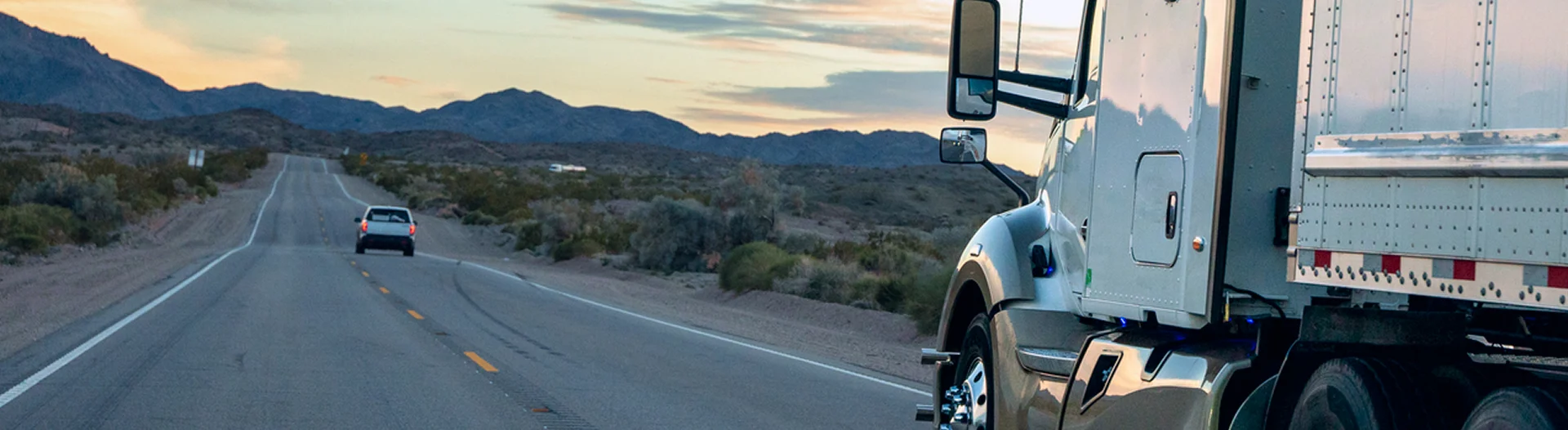
A commercial tractor-trailer has blind spots on all four sides large enough to conceal entire vehicles.
The front blind spot extends approximately 20 feet ahead of the cab, where the elevated driving position and the engine housing block the driver’s downward view.1 The rear blind spot stretches 30 feet or more behind the trailer, where no rearview mirror exists because the trailer blocks any direct line of sight.2 The left-side blind spot runs from behind the cab rearward at an angle covering at least one lane of traffic. And the right-side blind spot, the largest and most dangerous of all, extends from the cab door rearward across as many as two to three lanes, spanning the entire length of the trailer and beyond.3
The Federal Motor Carrier Safety Administration calls these areas "No-Zones" and has conducted public education campaigns warning motorists to avoid them.4 But the existence of a public awareness campaign does not shift the responsibility for a crash caused by a blind spot onto the vehicle that was struck. The driver of the truck has an obligation to know where the blind spots are, to check mirrors before every lane change and turn, and to use the equipment and technology available to minimize the areas the driver cannot see.
When a truck driver changes lanes into a vehicle that was in the right-side No-Zone, or makes a right turn that sweeps a cyclist or pedestrian under the trailer, the crash is not the result of an unavoidable limitation. It is the result of a driver who executed a maneuver without verifying the space was clear, and often the result of a carrier that equipped its trucks with the minimum mirror configuration and nothing more.
The Dimensions of the Problem
The scale of blind spot areas on a standard tractor-trailer combination is difficult to appreciate without specific measurements. A Class 8 tractor pulling a 53-foot trailer creates a combined vehicle length of approximately 70 to 75 feet. The driver sits in a cab elevated roughly 8 to 9 feet above the ground. The trailer extends behind the cab with no windows, no rearview mirror, and no direct line of sight to anything alongside or behind it.
The right-side blind spot is the most consequential. It begins just below and behind the passenger-side window of the cab and extends rearward and outward at an angle, covering the area from immediately adjacent to the trailer out to approximately two full lane widths.5 A passenger vehicle traveling in the right lane alongside the trailer, positioned between the cab and the rear axles, is invisible to the truck driver using standard mirrors alone. Multiple vehicles can occupy this zone simultaneously without the driver being aware of any of them.
The left-side blind spot is smaller but still significant. It begins behind the driver’s window and extends rearward at an angle, typically covering one lane of traffic alongside the trailer. Because the driver sits on the left side of the cab, the left mirror provides a better angle of coverage, but the blind zone still exists and still causes crashes.6
The front blind spot exists because the driver sits high above the ground and the engine housing, on conventional cab trucks, projects forward below the line of sight. A passenger car, a pedestrian, or a cyclist directly in front of the truck within approximately 20 feet of the bumper may be below the driver’s field of view.7 This blind spot is most dangerous in stop-and-go traffic and at intersections, where smaller vehicles and pedestrians can be positioned directly ahead of the truck without the driver’s knowledge.
The rear blind spot is a consequence of the trailer’s structure. Because no rearview mirror can see through a 53-foot trailer, the driver has no direct visibility of anything immediately behind the trailer. This zone extends approximately 30 feet behind the trailer’s rear doors.8 Any vehicle following within that distance is invisible to the truck driver. This makes the rear blind spot particularly dangerous in sudden braking situations, where the following driver may assume the truck driver is aware of their presence.
What Federal Regulations Require
The federal mirror requirement for commercial motor vehicles is found in 49 C.F.R. § 393.80.9 The regulation requires every bus, truck, and truck tractor to be equipped with two rear-vision mirrors, one at each side, firmly attached to the outside of the vehicle and positioned to reflect to the driver a view of the highway to the rear along both sides of the vehicle.10 The mirrors must meet the requirements of Federal Motor Vehicle Safety Standard No. 111 (49 C.F.R. § 571.111) in effect at the time the vehicle was manufactured.11
FMVSS No. 111 establishes minimum field-of-view requirements for mirrors. For trucks and multipurpose passenger vehicles with a gross vehicle weight rating of 11,340 kilograms (25,000 pounds) or more, Paragraph S8.1 of FMVSS No. 111 specifies the required mirror coverage areas.12 These standards ensure that the driver can see certain areas adjacent to and behind the vehicle, but they do not require, and mirrors physically cannot provide, coverage of the entire area around the vehicle.
The result is a regulatory floor that was designed around the limitations of flat and convex mirror technology. The standard ensures basic rearward visibility but does not eliminate the No-Zones. The blind spots that remain after proper mirror installation and adjustment are inherent to the mirror-based system.
The question in crash litigation is not whether the blind spots existed (they always do) but whether the driver took adequate precautions before executing the maneuver that caused the crash, and whether the carrier equipped the vehicle with technology that could have provided the visibility that mirrors alone cannot.
Where Mirrors Fall Short
Standard flat mirrors mounted on a tractor-trailer provide a narrow field of view focused on the lanes immediately adjacent to and behind the cab. They are effective for seeing vehicles that are directly alongside the rear portion of the cab or in the lane immediately behind the truck, but they cannot show the full length of a 53-foot trailer or the area beyond it.
Convex mirrors, which are typically mounted below or adjacent to the flat mirrors, provide a wider field of view by using a curved reflective surface. They can show objects that are outside the flat mirror’s field of view, including vehicles in adjacent lanes farther from the truck. However, convex mirrors introduce significant distance distortion.13 Objects viewed in a convex mirror appear smaller and farther away than they actually are. A vehicle that appears to be two lanes away in a convex mirror may be immediately adjacent to the trailer. A driver who relies on a convex mirror to judge the distance and speed of a vehicle in an adjacent lane is working with distorted information.
Cross-view mirrors, small convex mirrors mounted on the fender or hood to show the area immediately in front of the cab, address the front blind spot but are not required by federal regulation and are not universally installed. Fender-mounted mirrors angled downward can show the area along the right side of the cab at close range, reducing the most dangerous portion of the right-side blind spot during low-speed right turns. These are standard equipment on some trucks and absent from others.
The fundamental limitation of any mirror-based system is that mirrors require the driver to look at them. A mirror provides visibility only at the moment the driver directs attention to it. A driver who checks the right mirror, sees the lane is clear, and then takes five seconds to initiate a lane change has five seconds of elapsed time during which a vehicle could have entered the blind spot.
Mirrors provide snapshots, not continuous coverage.
The Crashes Blind Spots Cause
Blind spot crashes follow predictable patterns. The two most common configurations are lane-change crashes and right-turn crashes.
Lane-change crashes occur when a truck driver merges into an adjacent lane without detecting a vehicle occupying that lane. The vehicle is in the truck’s No-Zone, typically the right side, and the driver either did not check the mirror, checked the mirror but did not see the vehicle due to the blind spot’s geometry, or saw the vehicle in the convex mirror but misjudged its distance. The truck’s trailer swings into the occupied lane, striking the vehicle from the side. The struck vehicle may be pushed into another lane, forced off the roadway, or pinned against a barrier. FMCSA’s Large Truck and Bus Crash Facts report provides broader context on truck crash configurations.
In 2022, large trucks in fatal crashes had the following initial impact-point distribution:14
Right-turn crashes are among the most deadly blind spot events, particularly for pedestrians and cyclists. When a truck makes a right turn, the cab sweeps to the right while the trailer tracks inside the cab’s turning path. This geometry, called off-tracking, means the trailer’s rear wheels pass closer to the curb than the cab. A pedestrian in the crosswalk or a cyclist at the curb who is alongside the trailer during the turn may be directly in the right-side blind spot. The driver, focused on the cab’s path and any vehicles ahead, may never see the person alongside the trailer. The trailer’s rear wheels strike or roll over the pedestrian or cyclist.
These crashes are frequently fatal because the victim is caught between the trailer and the curb with no escape path, and the driver has no awareness of the contact.15
Camera Monitoring Systems
Camera monitoring systems represent a technological alternative to traditional mirrors that directly addresses the blind spot problem. These systems use cameras mounted on the exterior of the truck, typically at the mirror positions and on the trailer, to provide continuous video feeds to monitors inside the cab. The monitors display real-time images of the areas around the truck, including the No-Zones that mirrors cannot cover.
FMCSA has granted exemptions from the mirror requirement in 49 C.F.R. § 393.80 to several manufacturers of camera monitoring systems, determining that the camera systems provide a level of safety equivalent to or greater than traditional mirrors.16 Vision Systems North America received a five-year exemption renewal in January 2025 for its Smart-Vision high-definition camera monitoring system, which FMCSA found exceeds the field of view required by FMVSS No. 111 and the rear-vision mirrors currently installed by manufacturers.17 Other manufacturers, including Rosco and Convoy Technologies, have received similar exemptions.18
Camera systems also have limitations. The monitors require the driver to look at them, just as mirrors do. Screen glare, camera lens contamination from road spray, and system failures can degrade visibility. Drivers accustomed to mirrors may need training to adapt to camera-based visibility. Despite these limitations, the expanding body of camera system exemptions from FMCSA reflects a regulatory conclusion that camera technology can meet or exceed the safety performance of traditional mirrors.
Liability When Blind Spots Cause Crashes
When a crash results from a blind spot failure, the liability analysis centers on what the driver did before executing the maneuver and what equipment the carrier provided. The driver’s obligation is to check mirrors, and any available camera or sensor systems, before every lane change, merge, and turn. A driver who changes lanes without checking the right mirror, or who makes a right turn without verifying the crosswalk and curb area are clear, has failed to exercise the standard of care expected of a professional driver holding a commercial driver’s license.
The carrier’s obligation extends beyond the driver’s conduct. Under 49 C.F.R. § 393.80, the carrier must ensure the truck is equipped with properly adjusted mirrors meeting FMVSS No. 111 standards.19 A truck operating with a missing mirror, a broken mirror, or a mirror adjusted so that it does not provide the required field of view is in violation of the regulation. But the regulatory floor is the minimum standard. A carrier that equips its trucks with only the minimum mirror configuration (two flat mirrors and nothing else) when camera systems, cross-view mirrors, and blind spot detection sensors are commercially available and proven effective, has made a choice about how much visibility to provide its drivers.
When that choice results in a crash that better equipment would have prevented, the carrier’s decision to equip at the minimum rather than the available standard becomes a fact in the negligence analysis.
The carrier’s training obligations also factor into the liability assessment. Commercial truck drivers are trained to check mirrors frequently, to adjust mirrors before each trip, and to account for No-Zones in every driving decision. A carrier that does not train its drivers on the specific blind spot dimensions of its trucks, that does not require mirror checks before lane changes, or that does not provide instruction on using camera or sensor systems it has installed, has failed in its training obligation. Under 49 C.F.R. § 392.1, every motor carrier and its officers, agents, and representatives responsible for the management, maintenance, operation, or driving of commercial motor vehicles must comply with the applicable safety regulations.20
Sources
- [1] Federal Motor Carrier Safety Administration, Our Roads, Our Responsibility: Truck No-Zone Infographic.
- [2] Id.
- [3] Id.
- [4] Federal Motor Carrier Safety Administration, Our Roads Campaign.
- [5] Federal Motor Carrier Safety Administration, Our Roads, Our Responsibility: Truck No-Zone Infographic.
- [6] Id.
- [7] Id.
- [8] Id.
- [9] 49 C.F.R. § 393.80, Rear-vision mirrors.
- [10] 49 C.F.R. § 393.80(a).
- [11] 49 C.F.R. § 571.111, Federal Motor Vehicle Safety Standard No. 111, Rear visibility.
- [12] 49 C.F.R. § 571.111, Paragraph S8.1.
- [13] National Highway Traffic Safety Administration, DOT HS 812 300, Rear Visibility Report.
- [14] Federal Motor Carrier Safety Administration, Large Truck and Bus Crash Facts 2022.
- [15] National Transportation Safety Board, Safety Investigation Report SIR-18/03.
- [16] Federal Register, Parts and Accessories Necessary for Safe Operation: Exemption Renewal from Vision Systems North America, 90 Fed. Reg. (Jan. 16, 2025).
- [17] Id.
- [18] Id.
- [19] 49 C.F.R. § 393.80(a).
- [20] 49 C.F.R. § 392.1, Scope of the rules in this part.