The History of ExxonMobil Baton Rouge, Louisiana’s Largest Integrated Refining Complex
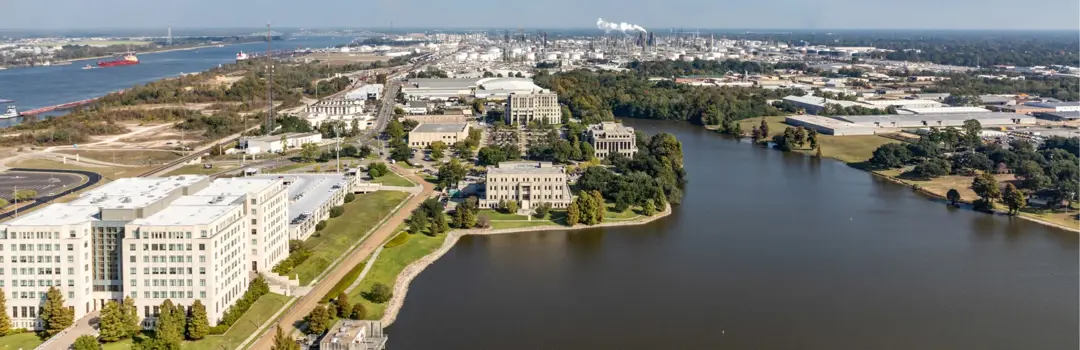
Drive north along Scenic Highway from downtown Baton Rouge, and within minutes, the Louisiana State Capitol disappears behind a skyline of distillation towers, flare stacks, and miles of interconnected piping. The ExxonMobil Baton Rouge complex stretches across roughly 2,100 acres on the east bank of the Mississippi River. Comprising nine separate plants staffed by approximately 6,000 workers, it processes more than half a million barrels of crude oil every day. It is the sixth-largest refinery in the United States, the largest integrated refining and chemical operation in Louisiana, and one of the most consequential industrial sites in American history.
In 1908, this very patch of land was a cotton plantation. By the 1920s, it was the largest refinery in the world. In 1942, engineers working here built the machine that helped the Allies win World War II, a piece of technology so important that the American Chemical Society later designated it a National Historic Chemical Landmark. The facility has operated continuously for more than 115 years, through world wars, corporate transformations, technological revolutions, and environmental reckonings. Its story is the story of modern petroleum refining and, in many ways, the story of Baton Rouge itself.
From Cotton Fields to Crude Oil
The Standard Oil Company of Louisiana was formally chartered on April 13, 1909, as a wholly owned subsidiary of Standard Oil Company of New Jersey, the holding company at the apex of John D. Rockefeller's petroleum empire. At the time, Standard Oil controlled an estimated 91% of American oil refining. Construction began immediately on a large tract of former cotton-plantation land along the Mississippi River, just upriver from downtown Baton Rouge at what is now 4045 Scenic Highway.
Baton Rouge was chosen for strategic reasons that remain relevant today. The Mississippi River provided deep-draft access for oceangoing tankers. The site sat close to Louisiana's emerging oil fields, including the Caddo Parish fields of northern Louisiana, discovered in 1905, and the Jennings oil field, the state's first commercial oil strike. It was also near important pipeline routes to the Mid-Continent reserves of Oklahoma and Arkansas.
Within a year of groundbreaking, the refinery employed roughly 700 workers and processed about 1,800 barrels of crude per day, focusing on kerosene production for the lamp-oil market. Photographs from those earliest years, preserved at LSU Libraries Special Collections, capture mule teams grading earth, workers lining up for pay, damage from a 1909 hurricane, and the arrival of the first trainload of crude oil from Muskogee, Oklahoma.
The 1911 Supreme Court dissolution of Rockefeller's Standard Oil trust into 33 subsidiary companies did not disrupt Baton Rouge operations. Standard Oil of Louisiana remained under the control of the reorganized Standard Oil Company of New Jersey, and the refinery continued to expand without interruption. By the late 1920s, the facility had grown to approximately 1,600 acres with more than 5,000 employees, making it the largest refinery in the world. Product lines expanded in lockstep with demand: a paraffin plant in 1911, lubricating oil production in 1913, asphalt in 1914, and thermal cracking stills in 1917 to meet the surging gasoline appetite of the automobile revolution.
Standard Oil didn't just reshape Baton Rouge's economy; it became a part of the city's identity. The company published the Stanocolan newsletter beginning in 1924, and the refinery's "Stanocola Band" even played at the dedication of LSU's current campus in 1926. As one LSU history professor put it: when Standard Oil arrived in 1909, it transformed Baton Rouge "almost overnight into a high-tech center."
The Invention That Changed Refining & Helped Win World War II
The single most consequential event in the refinery's history occurred in the early morning hours of May 25, 1942, when the world's first commercial fluid catalytic cracking (FCC) plant, designated Powdered Catalyst Louisiana (PCLA) No. 1, began processing petroleum at Baton Rouge. Standing 19 stories tall and containing an estimated 6,000 tons of steel and 85 miles of pipe, the unit initially cracked 13,000 barrels per day of heavy gas oil into high-octane gasoline. Within 12 days of startup, it had reached 128% of its design capacity.
To understand the significance of this, it’s important to first understand what came before. Before FCC, refiners relied on less efficient methods to convert crude oil into usable fuel. Thermal cracking, introduced in 1913, used brute-force heat and pressure to break heavy hydrocarbons into gasoline-range molecules, but it yielded low-octane fuel. Eugene Houdry's fixed-bed catalytic cracking process, commercialized in 1937, was a significant improvement, achieving higher octane and roughly double the gasoline yield. However, it required periodic shutdowns to regenerate the catalyst, making it a semi-batch process with inherent capacity limits.
FCC solved these problems through a concept that was revolutionary for its time: continuous circulation of powdered catalyst between a reactor and a regenerator, with no shutdowns required. The technology emerged from the Catalytic Research Associates consortium, organized in late 1938 and which eventually included Jersey Standard, M.W. Kellogg Company, Standard Oil of Indiana, and several other major firms. More than 1,000 technical experts participated in what was described as the largest coordinated scientific effort directed at a single industrial project before radar and the Manhattan Project.
FCC's impact on the war effort was immediate and immense. Allied aircraft running on 100-octane fuel enjoyed a 15-30% advantage in engine power for takeoff and climbing, 25% more payload capacity, and roughly 10% greater maximum speed compared to Axis planes that were burning lower-octane fuel. The technology enabled the U.S. petroleum industry to increase aviation fuel output by an estimated 6,000% in the three years following PCLA No. 1's startup. By June 1945, the Baton Rouge refinery alone had produced its one billionth gallon of aviation fuel. By war's end, 34 FCC units were operating across U.S. refineries.
Baton Rouge also became what some historians have called the "Cradle of the Synthetic Rubber Industry." The world's first butyl rubber plant was constructed at the site to replace natural rubber supplies cut off by Japan's occupation of Southeast Asia. Together with Jersey Standard's sister refinery in Baytown, Texas, the Baton Rouge complex supplied 29.1% of total U.S. butadiene production from 1943 through 1945. PCLA No. 1 itself operated for 21 years before being shut down in October 1963. On November 3, 1998, the American Chemical Society designated the fluid bed reactor at Baton Rouge as a National Historic Chemical Landmark.
Standard Oil, Esso, Exxon, ExxonMobil: A Corporate Lineage
The facility's corporate ownership has changed names several times over the past century, reflecting the consolidation of the American oil industry. After the 1911 trust dissolution, Standard Oil of Louisiana continued to operate under the umbrella of Standard Oil of New Jersey, commonly known as Jersey Standard. In 1926, the parent company introduced the "Esso" brand, a phonetic rendering of the initials "S.O." for Standard Oil. Standard Oil of Louisiana was formally absorbed into its parent in 1944, ending its status as an independent subsidiary, and domestic operations were later consolidated under Humble Oil & Refining Company in 1959.
The most visible rebranding came in 1972, when Standard Oil of New Jersey officially renamed itself Exxon Corporation. The name "Exxon" had been selected from hundreds of computer-generated options, then tested linguistically and psychologically before adoption. Humble Oil became Exxon Company, U.S.A. Then, on November 30, 1999, Exxon Corporation and Mobil Corporation completed their merger to form ExxonMobil Corporation, one of the largest corporate mergers in history.
Inside Louisiana's Largest Integrated Refining Complex
Today, the ExxonMobil Baton Rouge complex comprises nine interconnected facilities spread across roughly 2,100 acres on the east bank of the Mississippi River. The anchor is the Baton Rouge Refinery, with an operating capacity commonly cited at 522,000 to 522,500 barrels per day, making it the sixth-largest refinery in the United States. The refinery produces approximately 300 products and grades, including motor gasoline, diesel, jet fuel, aviation gasoline, lubricating oils, waxes, and petroleum coke.
Adjacent to the refinery is the Baton Rouge Chemical Plant, ExxonMobil's largest chemical facility worldwide. Its steam cracker produces 975,000 metric tons per year of ethylene, along with propylene, butadiene, benzene, and a range of specialty chemicals, including synthetic rubbers and plasticizers.
The complex also includes a plastics plant that produces more than 467,000 metric tons per year of low-density polyethylene, a polyolefins plant where a $500+ million expansion completed in December 2022 doubled polypropylene capacity, a resin finishing plant, the Port Allen Lubricants Plant across the river on the west bank, and the Anchorage Chemical Terminal connecting to pipeline systems.
How the Complex Operates
What makes this an "integrated" operation, and what distinguishes it from a standalone refinery, is the physical and chemical interconnection between refining and petrochemical production. The refinery produces naphtha and gas oils that feed directly via internal pipelines to the chemical plant's steam cracker. That cracker thermally breaks these feedstocks at roughly 800°C in the presence of steam, producing olefins (primarily ethylene and propylene) that flow directly to the plastics and polyolefins plants for conversion into polyethylene and polypropylene. The complex shares utilities through its own 85-megawatt gas turbine combined heat and power plant, eliminating transportation costs for intermediate products.
Crude oil reaches the facility through multiple pathways. The Genesis Energy pipeline, built via a $125 million investment, connects from the Port Hudson terminal. The Sentinel Midstream system delivers crude from St. James across 122 miles. The Capline Pipeline, reversed in 2021, now delivers crude southbound from Patoka, Illinois, connecting Canadian and Midwestern supplies to the Gulf Coast. The LOOP deepwater terminal offshore provides access to imported and Gulf of Mexico crudes. Finished products leave by pipeline, Mississippi River barge, rail, and truck.
The entire operation runs 24 hours a day, 365 days a year. Four shift teams work 12-hour rotating schedules, cycling between day and night duty. During major maintenance turnarounds, which can last 30 to 90 days, workers may pull extended shift blocks with minimal days off. The $230 million BRRIC modernization, completed in early 2024, upgraded crude processing capacity, expanded feedstock flexibility, and achieved a voluntary 10% reduction in volatile organic compound emissions.
The facility employs approximately 6,000 workers, both direct employees and contractors, making ExxonMobil the largest private employer in East Baton Rouge Parish. The workforce includes dozens of specialized roles: board operators monitoring processes from control rooms, field operators inspecting equipment across the sprawling complex, maintenance mechanics and instrumentation technicians, pipefitters, welders, process and chemical engineers, safety and environmental specialists, and lab technicians running quality control.
The complex's economic footprint is enormous. Annual employee payroll exceeds $450 million. In the most recent reporting period, ExxonMobil paid $156.6 million in Louisiana taxes, including $100.9 million to East Baton Rouge Parish alone, making the company the parish's largest single taxpayer. The refinery spends roughly $575 million annually on procurement, and its signature workforce development program—the North Baton Rouge Industrial Training Initiative, founded with Baton Rouge Community College in 2012—has produced more than 650 graduates, with approximately 85% hired into industry positions. Meanwhile, a $100 million-plus investment is underway to produce ultra-pure isopropyl alcohol for semiconductor manufacturing by 2027, signaling the complex's continued evolution into new markets.
Major Incidents & Regulatory History at the Baton Rouge Complex
With over a century in operation, the Baton Rouge complex has a long history of technological achievements and serious, life-changing incidents. Although the details differ, these incidents have a common thread: neglected maintenance, ignored safety standards, and other employer failures.
1989 Gas Explosion
On Christmas Eve 1989, during an extreme cold snap, gas released from fuel storage tanks at the refinery ignited and exploded with enough force to register 3.2 on a seismograph in New Orleans, 75 miles away. Eight storage tanks holding more than 4 million gallons of oil and lubricants were engulfed, and the fire burned for approximately 15 hours before crews finally extinguished it the following day. Two workers were killed: a contract worker trapped in a burning pickup truck near the blast site, and an Exxon employee in a destroyed office building. Windows shattered as far as six miles away, including at the Louisiana State Capitol about a mile to the south. The National Guard was activated, and roughly 8,000 damage claims were filed by area residents. An investigation attributed the explosion to corrosion of a pipeline, exacerbated by the extreme cold.
1993 Steel Piping Rupture
Less than four years later, at approximately 4:21 a.m. on August 2, 1993, a carbon steel piping elbow ruptured in the refinery's East Coker Unit, causing an explosion and subsequent fire that burned for nearly three hours. Two Exxon employees were killed. The piping elbow had been fabricated from carbon steel where chrome-molybdenum steel, which resists sulfur corrosion, should have been used. The defect was hidden from visual inspection by asbestos insulation. The unit, which had been designed and built by a third-party contractor in the early 1960s, was destroyed in the fire. Thick smoke, ash, and debris, including asbestos particles, drifted over the residential neighborhood directly across Scenic Highway. More than 8,500 residents ultimately filed suit. After litigation that dragged on for nearly 30 years, the Louisiana Supreme Court affirmed that ExxonMobil was 100% at fault.
2016 Unintentional Pressure Release
On November 22, 2016, an incident in the refinery's sulfuric acid alkylation unit was the subject of a formal investigation by the U.S. Chemical Safety and Hazard Investigation Board (CSB). Two operators preparing to activate a spare isobutane pump found the handwheel and gearbox on a plug valve inoperable. Following an accepted but unwritten practice, one operator attempted to remove the gearbox. Of the roughly 500 plug valves in the unit, this valve was one of only 15 that was of an older design, in which the gearbox support bracket was attached to the pressure-retaining top-cap. When the operator removed bolts to detach the gearbox, he inadvertently breached the pressure boundary, releasing approximately 2,000 pounds of pressurized isobutane.
The flammable vapor cloud ignited within 30 seconds upon reaching an energized welding machine about 70 feet away. One ExxonMobil employee and three contractors were severely burned. The CSB's final report found failures in hazard identification, human factors evaluation, written procedures, and training, noting that 97% of the unit's plug valves had already been updated to a safer design. This one had not.
2020 Fire
In February 2020, a fire broke out in elevated piping at the refinery, turning the night sky orange and sending up a plume that was visible for miles. ExxonMobil's 300-plus-person volunteer emergency response team extinguished the blaze by early morning. No injuries were reported.
Federal regulators have also taken action over the years. In 2011, as part of a national refinery inspection program launched after the 2005 BP Texas City disaster, OSHA cited the Baton Rouge refinery with 22 violations and proposed a $126,000 penalty. Following the 2016 fire, OSHA issued nine citations totaling approximately $165,000, including a repeat violation for failing to conduct required inspections of piping. On the environmental side, a 2005 Clean Air Act settlement required ExxonMobil to spend more than $570 million on emission control technologies across all seven of its U.S. refineries, while a 2017 settlement over flare operations at facilities, including Baton Rouge, carried a $2.5 million civil penalty and approximately $300 million in plant upgrades. At the state level, the Louisiana Department of Environmental Quality reached a $2.329 million settlement in 2013–2014 addressing violations from 2008 to 2013 at four Baton Rouge facilities. At the time, this was the agency's largest settlement with any company.
ExxonMobil has stated it invests more than $200 million annually in environmental programs at its Baton Rouge sites and has reported a 53% reduction in Toxic Release Inventory emissions over a recent five-year period. The company maintains a volunteer emergency response force of over 300 dedicated responders and operates a community notification system.
A Legacy That Spans Generations & Continues to Evolve
The ExxonMobil Baton Rouge complex occupies a singular position in American industrial history. It was the site where Standard Oil planted its flag in Louisiana's emerging petroleum frontier, transforming a quiet river town into an industrial powerhouse. It was where engineers cracked the code on continuous catalytic cracking, a technology that changed the trajectory of World War II and still underpins the production of roughly half the world's gasoline. And it remains one of the nation's largest and most complex integrated refining and petrochemical operations, employing thousands of people, generating hundreds of millions in tax revenue, and converting crude oil into everything from jet fuel to the raw materials for surgical gowns.
That legacy is not without tension. At least four workers have died in major incidents over the decades, and the facility has drawn persistent regulatory attention from OSHA, the EPA, and state agencies on safety and environmental compliance. The long arc from cotton plantation to petrochemical colossus mirrors the broader story of Louisiana's complicated relationship with the oil industry, the economic transformation and the environmental costs, the jobs created and the communities impacted.
What is not in dispute is the facility's outsized role in the history of American energy, a role that continues as ExxonMobil invests billions in modernization and pivots toward new markets, even as the world's energy landscape shifts beneath it. And as the complex ages and evolves, the obligations to worker safety and environmental protection only grow. When incidents do occur, the workers and families affected deserve answers, accountability, and fair compensation. This truth applies regardless of how large, how historic, or how economically important a facility may be.