Cleaning & Clearing Jams: The How, Where & Why Behind Worker Injuries
A food processing worker reaches into a mixer to pull out a clog.
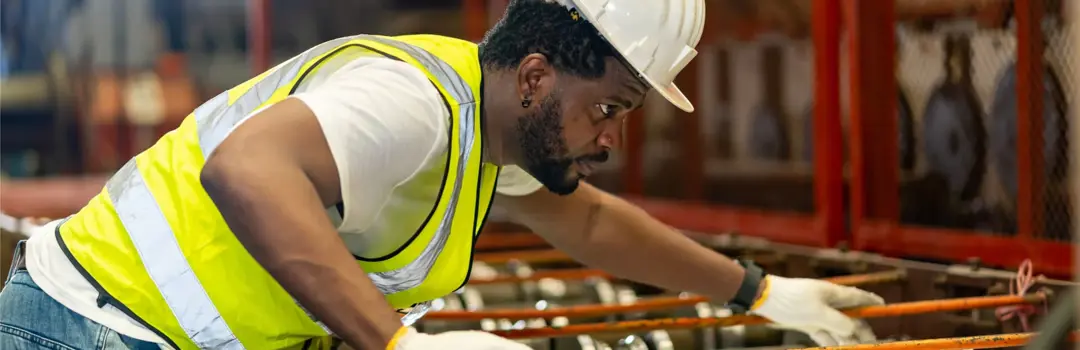
A recycling sorter leans over a moving conveyor to clear a blockage.
A press operator wipes down a die between production runs.
A sanitation worker climbs inside an industrial kettle to clean it before the next shift.
These tasks happen countless times a day in workplaces across the United States. They are a necessary part of keeping operations running. They are also responsible for a disproportionate share of serious workplace injuries and deaths.
According to the National Safety Council's analysis of Bureau of Labor Statistics data, 48 workers died in 2023 in incidents associated with failures to control hazardous energy—including during tasks like cleaning, maintenance, and servicing equipment. Another 53 workers died after being caught in running machinery during regular operation, which may include incidents related to clearing jams that occur mid-shift. Across both categories in 2021 and 2022, the NSC reported more than 44,000 nonfatal injuries resulting in days away from work, job restrictions, or transfers.
Many of these workers were not operating the machine that killed or injured them. They were cleaning it, clearing it, or preparing it for the next cycle.
And in case after case, the safety measures that should have been in place were not.
What “Cleaning & Clearing Jams” Actually Means
There is nothing simple about cleaning equipment or clearing a jam. These tasks, although common in industrial work, place workers in direct contact with some of the most dangerous parts of machinery as they attempt to keep operations moving.
Clearing a jam refers to the task of removing material of some kind that has become stuck inside a machine. This could be anything from compacted dough in a bakery mixer to a clog in a feed hopper at a grain facility. A worker may need to reach into the machine, use tools to dislodge the material, or physically enter the equipment (if it’s large enough) to access the blockage.
Cleaning includes a range of tasks: wiping down equipment between production runs, sanitizing food contact surfaces, removing accumulated debris from underneath or around conveyor belts, hosing out tanks or vessels, and performing end-of-shift cleanup inside and around machinery.
When These Tasks Get Treated as Routine or Low-Risk
One of the most dangerous aspects of any industrial work, including cleaning equipment and clearing jams, involves more than just the machinery itself. It relates to the way these tasks are perceived by those who assign and oversee them.
Cleaning and clearing jams happen frequently. In many facilities, they happen multiple times per shift. Because workers may perform these tasks over and over without incident, a false sense of security can develop within the workplace.
Supervisors may treat them as quick fixes that don't require a full shutdown.
Safety procedures may be relaxed or skipped because "it will only take a minute."
The machine may be switched off at the control panel, but never fully locked out and de-energized.
This perception is not created by the workers themselves. It is shaped by the workplace culture that employers establish and reinforce. When production speed is valued over safety procedures, when lockout/tagout is treated as optional for "minor" tasks, and when staffing levels don't allow enough time for proper shutdowns between runs, the message to workers is clear: get it done fast, and get back to production.
This opens the door to preventable injuries and worse.
In November 2025, OSHA cited Taylor Farms New Jersey with 16 safety violations and more than $1.1 million in penalties after a worker was killed while cleaning and sanitizing equipment at a vegetable processing facility. Investigators found the company had failed to implement lockout/tagout procedures to protect workers during cleaning. The worker's employer, an outside temporary staffing agency, was also cited for failing to implement or provide training on lockout/tagout.
At a paper goods manufacturing plant in Coppell, Texas, a 56-year-old machine operator was killed while clearing a paper jam. On October 11, 2024, the worker entered the machine to dislodge the jammed material. While inside, his head and neck were caught and crushed between two pusher attachments. OSHA cited Brown Paper Goods Company for four lockout/tagout violations, including one repeat violation, with initial penalties totaling $132,400.
Why Equipment Moves or Restarts
When a worker is injured or killed while cleaning or clearing a jam, the question is always the same: why did the machine move or restart in the first place?
Resulting investigations and citations show a consistent pattern:
- Someone else restarts the machine. In facilities with multiple workers on a line, one person may not know that a coworker is inside, behind, or underneath a piece of equipment. Without a physical lock on the power source, the machine can be restarted at the push of a button.
- Automatic cycles resume. Many industrial machines are programmed to cycle on timers or sensors. A worker who enters the machine during what they believe is a pause may be caught when the system resumes automatically.
- Stored energy releases. Even when a machine's motor is turned off, it may retain hydraulic pressure, pneumatic force, or gravitational energy that can cause sudden movement. Without a complete de-energization and verification process, this stored energy can be released without warning.
- The shutdown was never complete. Turning off a machine at the control panel is not the same as locking it out. If the power source is not physically isolated and locked, the machine can be re-energized at any time. This is the exact scenario that OSHA's lockout/tagout standard (29 CFR 1910.147) is designed to prevent, and it is one of the most frequently violated standards in the country.
- Jammed material shifts. A blockage under pressure can suddenly release when a worker begins to dislodge it, causing the machine to lurch or components to move unexpectedly.
Which Machines Are Most Dangerous
While any machine with moving parts can injure a worker during cleaning, certain types of equipment present particularly serious risks.
Conveyor systems operate continuously during shifts and do not automatically slow or stop when they encounter obstructions. When workers reach across, under, or into the system to clear debris or jammed material, they may be seriously injured if the belt is still moving or has not been fully de-energized.
Presses, rollers, and forming machines exert powerful compressive or pulling forces. A worker clearing a jam from between rollers or wiping down a press die can be caught if the machine cycles unexpectedly.
Mixers, augers, and food processing equipment use rotating blades or helical flights that can entangle or pull in a worker's hands, arms, hair, or clothing. In July 2025, a 19-year-old sanitation worker at Tina's Burritos factory in Vernon, California, was killed while cleaning an industrial kettle that unexpectedly activated. Coworkers heard him calling for help and tried to shut off the machine, but they were unable to do so in time.
Compactors and crushers pose severe risks when workers enter the chamber to clear blockages or remove built-up material. If the machine is not locked out, a cycle can begin while the worker is inside.
Who Gets Hurt
The workers injured during cleaning and jam-clearing tasks are often among the lowest-paid employees in the facility.
Job titles associated with these incidents include machine operators, general laborers, sanitation crew members, and maintenance workers. In food processing, recycling, and manufacturing, many of the workers assigned to cleaning tasks are temporary, contract, or agency employees. They may receive minimal training, have limited familiarity with the specific equipment they are cleaning, and have less authority to push back against unsafe conditions.
The Tina's Burritos incident is a case in point. The 19-year-old victim was employed by an outside staffing agency, not directly by the factory. In the Taylor Farms case, the worker killed during sanitation was also employed through a temporary staffing agency, which OSHA cited separately for its own lockout/tagout failures.
Many of these workers earn wages at or near the federal or state minimum. They perform some of the most physically demanding and hazardous tasks in industrial workplaces, often during off-hours or overnight shifts when supervision may be limited. The imbalance between the risk they face and the compensation they receive raises serious questions about how employers value the safety of their workforce.
What Investigations Often Reveal
When federal or state safety investigators examine these incidents, they find the same failures.
Repeated across industries and facilities, they find:
- Guards were removed to give workers access to the machine for cleaning and were never reinstalled.
- Lockout/tagout procedures existed in a written manual but were not followed in practice, or were never trained on at all.
- Machines that jammed frequently were known to management, but no engineering solutions were implemented to address the pattern.
- Workers had raised concerns or reported near-misses, and nothing changed.
In August 2022, a worker at a Kansas plastics plant was killed while clearing a jam in a bagging machine. Upon investigating, OSHA inspectors found that duct tape had been placed over the safety interlock to prevent the machine from shutting down. The worker was caught in a rotating part and fatally injured. The agency proposed a $292,421 penalty for a range of violations related to machine guarding, lockout/tagout, improper training, and slip and fall hazards.
In March 2026, a Midwest commercial bakery was cited by OSHA after a worker broke their arm clearing dough from a machine on the production line. Inspectors found the company had repeatedly exposed employees to the same hazards and proposed penalties totaling $326,276.
These findings are not a surprise. They are the predictable outcomes of known hazards that employers chose not to address.
Where Accountability Lies
Cleaning equipment and clearing jams are necessary parts of industrial work. They cannot be eliminated. But the injuries and deaths that result from these tasks can be.
The safety measures are well established: full lockout/tagout before any worker interacts with a machine's moving parts, proper guarding that accounts for cleaning access, adequate training on the specific hazards of each task, sufficient staffing and time to perform shutdowns safely, and a workplace culture that treats every interaction with machinery as carrying real risk.
When employers cut corners on these protections, they are making a choice. And it is a choice that workers pay for with their safety, their health, and in too many cases, their lives.