The 120-Ton Blind Spot: When Railcars Move Without Warning, Workers Pay the Price
On July 6, 2024, a 27-year-old Union Pacific conductor was killed during a shoving operation at the railroad's Proviso Yard in Melrose Park, Illinois. According to initial reports, he had been certified as a conductor just 12 days earlier and had led a shoving movement only five times. He had never worked in that section of the yard and had received no territory-specific training.
When the engineer explicitly requested assistance, telling the yard controller that the 27-year-old conductor was unfamiliar with the territory, the controller responded, "Do what you can do... the conductor can walk the City Lead [Track] or shove... do what you can do." No help came. The National Transportation Safety Board's investigation placed blame squarely on Union Pacific for sending the conductor into the field without verifying that he could safely navigate the territory.
Sadly, this death was not a freak accident but merely one entry in a long, well-documented record of workers who have been injured and killed by railcars in industrial yards and switching operations across the United States. Since 1992, the Federal Railroad Administration's Switching Operations Fatality Analysis (SOFA) working group has examined more than 210 switching-related deaths, and the same failure patterns repeat year after year: inadequate communication, production pressure overriding safety protocols, and workers who never hear the machine approaching from behind.
What’s more, these incidents keep happening at alarming rates. In testimony before the U.S. House Committee on Transportation and Infrastructure in July 2024, FRA Administrator Amit Bose stated that the yard derailment rate for the nation's largest railroads was 51% higher than it had been a decade earlier and that three Class I employees had died on duty in rail yard accidents in 2023 alone.
When it comes to rail yard accidents and deaths, the details may change but the pattern does not.
What Most People Never See
For the millions of Americans who never set foot inside an industrial rail yard, a railcar is an abstraction, something glimpsed from a highway overpass or heard rumbling through a crossing. In reality, railcars are steel vessels weighing anywhere from 50,000 to 90,000 pounds when empty and up to 286,000 pounds fully loaded. That's the equivalent of roughly 95 passenger cars or three-and-a-half fully loaded semi-trucks.
Railcars come in many forms. Tank cars are cylindrical vessels carrying chemicals, petroleum, ethanol, and food-grade liquids in capacities up to 34,500 gallons. Covered hoppers transport grain, cement, fertilizer, and plastic pellets. Open-top hoppers haul coal, sand, and aggregates. Gondolas carry scrap metal and steel coils, and boxcars move packaged goods, paper, and appliances. Together, these railcars play a critical role in American industry.
These massive machines often show up at refineries, chemical plants, steel mills, grain elevators, and manufacturing facilities, and the reason why comes down to basic economics and physics. Steel wheels on steel rails reduce friction by 85 to 99% compared to rubber tires on asphalt, making rail transport dramatically more cost-effective per ton-mile. Another way to put it? A single railcar replaces three to four truckloads of freight; a 100-car train can replace 300 or more trucks on the road. And, for the more than 110 million tons of hazardous materials that travel by rail annually in the United States, purpose-built tank cars offer specialized containment that standard trucks simply cannot match.
The result is that thousands of industrial facilities across the country maintain internal rail networks where railcars are positioned, loaded, unloaded, and moved as part of daily operations. And that is where the danger lives—not on the mainline, where trains travel at speed and everyone knows to stay clear, but inside the yard, where railcars sit quietly among workers performing routine tasks, where the line between stationary equipment and deadly force in motion can disappear without warning.
The Work That Happens Around "Parked" Railcars
When a railcar is sitting on a track, it doesn't look dangerous. There is no visible flame, no exposed blade, no obvious chemical hazard; it looks inert. Harmless. This is the perception that makes industrial rail yards so uniquely treacherous.
Workers perform an extraordinary range of tasks in close proximity to railcars that may or may not be fully secured. Tank car loading and unloading requires climbing roughly 15 feet to access dome hatches, connecting hoses and loading arms, opening and closing valves, and monitoring fill levels, all while standing on top of or alongside equipment that weighs more than a house. Coupling and uncoupling cars requires workers to physically position themselves between massive steel objects. Inspections, sampling, valve maintenance, brake testing, and car cleaning all take place on, under, or immediately beside equipment that can begin moving with virtually no warning.
And how often do railcars move during a normal shift? Constantly. Scheduled switching operations reposition cars throughout the day. Unscheduled movements happen when production needs change, when incoming deliveries require space, when equipment needs repositioning, or when weather conditions force operational adjustments. At a busy refinery or chemical plant, railcar movements may occur dozens of times per shift. Each movement is supposed to be coordinated, communicated, and verified. In practice, however, each movement is another opportunity for the system to fail.
Who's in Charge? The Answer Is Complicated & That’s the Problem
The operational complexity of an industrial rail yard is itself a source of danger. At a typical facility, multiple parties share responsibility for railcar movement, and the handoff points between them are where communication fails most catastrophically.
Class I railroad crews—Union Pacific, BNSF, CSX, Norfolk Southern—deliver and retrieve cars from facility sidings. Third-party switching companies provide locomotives, crews, and yard management under contract. Plant employees handle internal positioning, set hand brakes, place wheel chocks and derails, and manage loading and unloading operations. Short-line railroads may provide first-and-last-mile service connecting industrial sites to the Class I network. In a single shift, a railcar might pass through the control of three or more separate organizations.
Communication between these parties relies on radio calls, hand signals, written schedules, and yard management software. The critical vulnerability is the moment when responsibility transfers, such as when a railroad crew releases cars to a plant-switching crew, or when a switching operation occurs near workers who believe the cars around them are stationary. When a contractor's conductor is moving cars at a refinery where plant workers are performing maintenance nearby, which organization's safety procedures must be followed? Who confirms that protective signals are placed? Who verifies that all personnel are clear before movement begins?
These are not hypothetical questions. They are the questions that investigators ask after someone is killed.
Silent, Massive & Unforgiving: The Physics Behind What Makes Railcars So Dangerous
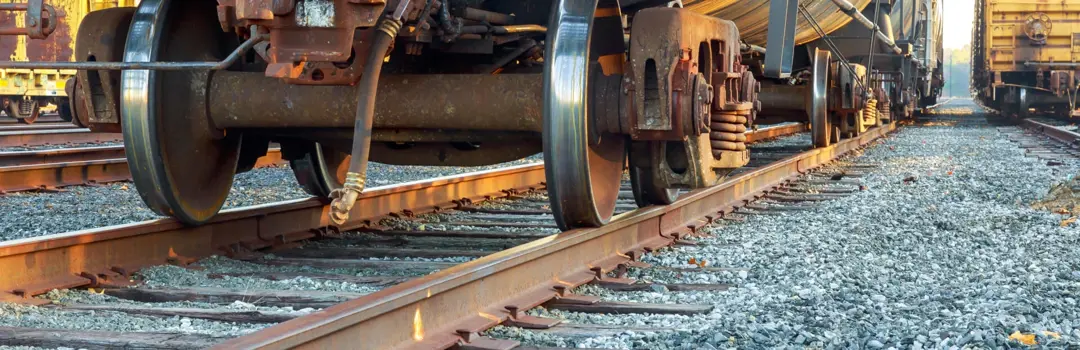
The fundamental danger of railcars is rooted in two physical properties: extreme mass and near-zero rolling friction. The contact patch of a steel wheel on a steel rail is roughly the size of a dime, producing a coefficient of rolling friction approximately one-tenth to one-twentieth that of rubber tires on pavement. Translation: A railcar rolls so easily on its track that almost nothing slows it down once it starts moving, and it does so with almost no sound.
On even a slight grade, an unsecured railcar will begin rolling under its own weight and, once moving, almost nothing will slow it without active braking. The movement is essentially silent. At yard speeds of one to five miles per hour, modern rolling stock on welded rail produces minimal sound, often far less than ambient noise in an industrial environment.
The math is sobering: A loaded railcar at just one mile per hour carries more momentum than a passenger car traveling at 60 miles per hour on a highway. At five miles per hour, a typical switching speed, a loaded railcar's momentum reaches roughly six times that of an automobile at highway speed. A human body cannot deflect, slow, or redirect this force. Upon contact, the railcar does not decelerate in any meaningful way. The crushing force is, for all practical purposes, unlimited.
As Rail Safe Training puts it, a rolling railcar has no means to notify workers of its approach—no horn, no wheel noise, no running engine. Workers wearing hearing protection in an industrial environment have virtually no auditory warning. By the time someone realizes a car is moving, the window to react may already be closed.
A Record of Tragedies That Tell the Same Story
The history of railcar fatalities in industrial and switching yards is both extensive and repetitive. The mechanisms behind how they happen are well-documented, with certain patterns repeating again and again. Recent NTSB investigations, OSHA citations, FRA safety bulletins, and union records reveal troubling similarities and situations that, all too often, could have and should have been avoided.
On August 6, 2023, a CSX conductor trainee was riding the side of an intermodal railcar during an eastbound shove move at Cumberland Yard in Maryland when he struck the handrail of a standing locomotive on an adjacent track. The clearance between the moving and stationary equipment was seven inches. Two months before that, on June 26, 2023, another CSX conductor trainee fell from an intermodal railcar during a nighttime shove move at the Seagirt Marine Terminal in Baltimore and was killed. CSX subsequently imposed a safety stand-down for 350 conductor trainees.
On April 2, 2019, a 17-year employee at ArcelorMittal's Indiana Harbor steel mill in East Chicago, Indiana, was killed when the locomotive he was operating struck a railcar on an adjacent track. OSHA found two serious safety violations and fined the company $14,000. On October 28, 2022, a conductor for PSC Group, a contractor providing product handling at petroleum and chemical facilities, was killed during a shoving movement at ExxonMobil's Lubricant Blending and Packaging Plant in Beaumont, Texas. The NTSB determined that the conductor had entered the railcar's danger zone and that the engineer failed to follow safety procedures when radio contact was lost.
On September 17, 2023, a CSX carman with 19 years of service was crushed between two railcars by a remote-controlled train at CSX's yard in Walbridge, Ohio. The union representing the carman noted this was the third carman fatality involving remote-control locomotives. On June 16, 2025, another carman was struck during remote-control switching at U.S. Steel's Flintridge Yard in Alabama while riding the lead car in a shove through a section with close clearances. He radioed for an emergency stop, but it was not enough.
In each case, investigators found the same contributing factors: communication breakdowns, close clearances, limited visibility, insufficient training, production pressure, or some combination of all five.
Safety Controls Exist—on Paper
The regulatory framework for protecting workers around railcars is well-established. Blue flag or blue signal protection, codified in 49 CFR Part 218, Subpart B, is the railroad equivalent of lockout/tagout. It requires a clearly distinguishable blue flag by day and blue light at night whenever workers are on, under, or between rolling equipment. No equipment may be moved or coupled with protected cars while blue signals are displayed. OSHA's general industry standards require positive protection, including wheel stops, wheel chocks, and derails, to prevent railcars from moving during loading or unloading operations.
These protections work when they are consistently applied. The problem is that they depend entirely on human compliance in environments where time pressure, unclear responsibility between multiple organizations, and the quiet danger of routine all work against compliance every single shift.
The NASA/FRA Confidential Close Call Reporting System has documented real-world blue flag violations with disturbing clarity. In one report, a conductor coupled into cars under blue flag protection during a yard switching move. In another, a worker reported that yardmasters routinely told crews that flags were down to speed up operations. An FRA-funded study of blue flag products found that of 11 commercially available blue flag devices tested, five did not meet any safety standards beyond the bare minimum required by federal regulations. The shades of blue, sizes, shapes, and placements differed enough to increase the risk of misidentification.
Why Do the Same Railcar Incidents Keep Happening?
When a railcar accident happens, an investigation is launched. Reports are filed. Recommendations are made. And months later, the same type of incident occurs at a different yard. Why?
At its root, the problem is systemic.
Railroad employment has been cut by roughly 30% since 2016 under cost-cutting measures that have impacted the entire industry. Conductor classroom training at some major railroads had been as short as four weeks before trainee deaths forced changes, and the nation's largest rail union has said that railroads have been hiring new conductors as quickly as possible and rushing them out to work. Multiple fatalities in 2023 and 2024 involved trainees with only weeks or months of experience.
The penalty structure for companies that choose to gamble with their workers’ lives in the name of increased productivity remains woefully inadequate. ArcelorMittal paid $14,000 for the safety violations connected to an employee’s death at a facility where nearly 400 workers have been killed over its operational history. An investigation by ProPublica found that the total fines for all Class I railroad reporting failures in 2022 amounted to just $30,011—against companies with $108 billion in combined revenue. When the financial consequence of a worker's death is a rounding error on a quarterly earnings report, the incentive structure speaks for itself.
The FRA's yard worker safety study, based on focus groups with frontline employees, found that pressure and intimidation produce predictable outcomes:
- Less effective training
- Underreporting of injuries and unsafe conditions
- Under-maintained equipment
- Fatigued employees
- Unsafe work practices driven by the demand to rush
Workers told researchers that safety rules exist on paper but are systematically undermined by production demands. The study concluded that railroad yards "are not analogous to any other transportation or industrial facility," citing large, dark environments with debris and large, sometimes silent, moving equipment.
Accountability Requires More Than Another Safety Stand-Down
The reality of railcar fatalities is that they are NOT mysterious or unforeseeable. In fact, these incidents are so predictable, so well-understood, and so consistently repeated that each one functions less as an unexpected tragedy and more as a consequence of systemic choices.
Close clearances kill workers in switching operations year after year. Inexperienced workers are sent into unfamiliar territory without adequate preparation. Production pressure erodes safety procedures that exist on paper. Silent, massive railcars move through spaces where humans are working, and when something goes wrong, physics delivers an outcome that no emergency stop can reverse.
What changes the equation is not another bulletin reaffirming existing policies; it's meaningful accountability. This accountability looks like financial penalties that actually affect corporate decision-making, mandatory territory-qualification verification before solo assignments, proximity detection systems that remove human compliance from the equation, and an industry culture that treats the 120-ton blind spot as the engineering problem it actually is rather than an acceptable cost of doing business.
Workers who are injured or killed in railcar incidents, and the families left behind, deserve more than a safety alert issued after the fact. They deserve answers about what went wrong, who was responsible, and why known hazards were left unaddressed. At Arnold & Itkin, we investigate serious industrial accidents to uncover exactly what happened and why. We stand with workers and families who have been harmed by preventable failures in environments where safety was treated as secondary to production.
- Categories