Why Hydrogen Sulfide Kills Wastewater Workers So Quickly

On August 27, 2025, two water treatment workers and a sewage treatment worker arrived to perform maintenance and repairs at a septic lift station in Trinity County, Texas. They were not supposed to be doing any underground work that day, but a sewage line below ground came loose, and sewage started backing up, interfering with their access to the lift station. One worker climbed down into a nearby manhole, about 20 feet below ground, in order to perform a quick fix and stop the flow.
He never came back up.
Soon after the first worker lost consciousness, a second worker descended after him. He, too, collapsed within moments. The final worker remaining above ground went in to save them both. He was the only one equipped with a personal gas monitor, and the alarm was sounding as he climbed down, indicating the presence of hydrogen sulfide (H2S). He collapsed before he could resurface. Before their bodies could be recovered, the manhole had to be fully ventilated, and the recovery team needed gas monitors and self-contained breathing apparatuses.
All three of these workers died from hydrogen sulfide exposure, which causes sudden yet preventable deaths. These were experienced workers who were owed proper equipment and specialized training by their employers, and they were each failed by their respective companies. They paid the price with their lives.
A Pattern of Preventable Deaths
Just a couple weeks before the Trinity County deaths, in Mobile, Alabama, two sewer workers died under nearly identical circumstances. One worker was trapped while digging a sewer bypass, and a second worker went to help him. Both were overcome by hydrogen sulfide. A third worker went to investigate and help but started to lose consciousness. He was able to climb out of the hole while disoriented, but by the time firefighters came, it was too late to save the first two workers from the toxic exposure.
Their employer, Construction Labor Services, had been cited by OSHA just two years prior at a different manhole in Mobile, which included a citation of not notifying workers of a hazard.
On August 19, 2024, a senior technician died in a confined space at a wastewater plant in Socorro, Texas. After a couple minutes had passed with no contact from him, a coworker found the 34-year-old dead from hydrogen sulfide exposure and potential drowning in a wastewater treatment tank.
On January 17, 2017, one worker in Key Largo, Florida went 15 feet down a manhole, when he stopped responding to coworkers. A second man went down to investigate, but he also stopped contact. A third worker went to help. By the time firefighters arrived, the first responder couldn’t fit his air tank down with him, so he took it off so he could still attempt a rescue. He was unconscious in seconds. A second firefighter was able to keep his air tank on him and pulled the first firefighter out, who would make it to the hospital in critical condition. The three workers, however, had succumbed to hydrogen sulfide exposure.
These tragedies are not isolated incidents. The same deadly pattern repeats itself at wastewater facilities with disturbing regularity.
What Hydrogen Sulfide Exposure Means for Wastewater Workers
Hydrogen sulfide is a colorless gas that is produced naturally when organic matter decomposes. In wastewater systems, it forms constantly as sewage breaks down in pipes, tanks, and collection points. Workers encounter it during routine tasks, such as servicing pumps, inspecting lines, clearing blockages, and entering lift stations or wet wells for maintenance.
The gas is often called "sewer gas", “manure gas”, or “swamp gas” for good reason. According to OSHA, sanitation workers cleaning or maintaining municipal sewers and septic tanks face regular exposure risks. So do treatment plant maintenance crews, pump technicians, inspectors, and contractors who are called in for repairs.
What makes hydrogen sulfide particularly treacherous for sewage and wastewater workers is where the gas accumulates. This heavier-than-air gas sinks and pools in low-lying spaces, which are exactly the kinds of spaces these workers must enter. Manholes, wet wells, digesters, underground vaults, and enclosed tanks can harbor lethal concentrations even when the air just a few feet above seems perfectly safe.
How Hydrogen Sulfide Disables & Kills People Within Seconds
At low concentrations, hydrogen sulfide announces itself with an unmistakable smell: rotten eggs. Most people can detect it at less than 1 part per million (ppm). But that warning system fails precisely when workers need it most.
According to OSHA, at concentrations between 100 and 150 ppm, the olfactory nerve can become paralyzed. The smell vanishes. Workers may believe the gas has dissipated when in fact they've simply lost the ability to detect it.
The OSHA permissible exposure limit for hydrogen sulfide is 20 ppm over an eight-hour shift, with a ceiling of 50 ppm for no more than 10 minutes. NIOSH classifies 100 ppm as immediately dangerous to life or health (IDLH). But in confined spaces where the gas has accumulated, concentrations can far exceed these thresholds.
Hydrogen Sulfide (H2S): Health Effects by Exposure Level
Source: OSHA
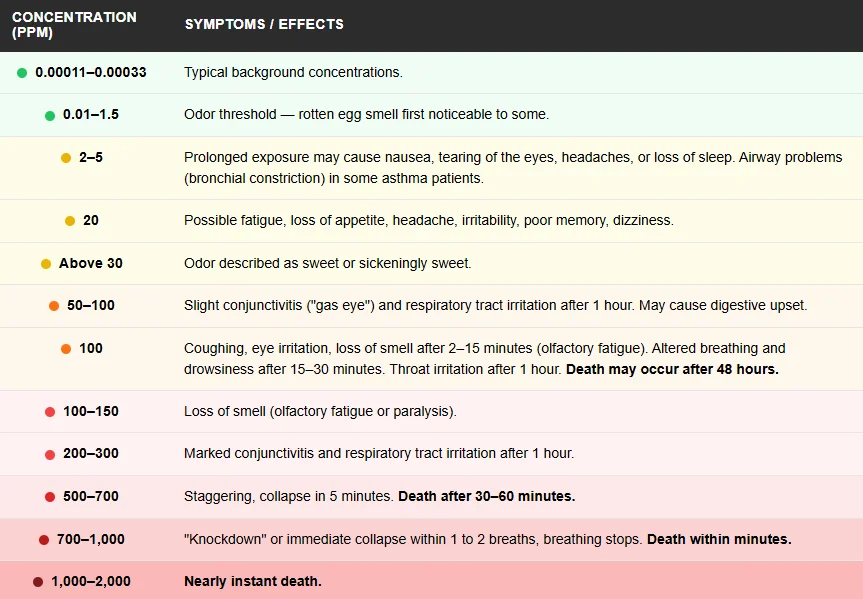
This rapid incapacitation is what makes hydrogen sulfide so deadly in wastewater settings. A worker descending into a manhole may take a single breath of contaminated air and lose consciousness before they can call for help or climb back out. They fall, often into standing sewage, and within moments are beyond rescue by anyone without supplied air.
The Unique Dangers of Wastewater Environments
Wastewater facilities present conditions that make hydrogen sulfide exposure particularly likely and particularly deadly.
The gas forms continuously as sewage decomposes. A CDC investigation of a fatal incident at an Omaha wastewater plant found that during the sewage transit of over 25 miles of pipe, especially in summer heat and periods of low flow, the sewage became anaerobic, creating the ideal conditions for hydrogen sulfide production. When ventilation systems malfunctioned at that plant (due to a power outage), investigators measured concentrations up to 200 ppm at a doorway, and calculated that levels reached 1,000 to 2,000 ppm in the area where the worker was overcome.
That same CDC investigation revealed another disturbing find: 76% of the plant's workers reported suffering at least three symptoms associated with hydrogen sulfide exposure in the two weeks prior to the tragedy, including cough, eye irritation, and nasal irritation.
Not only can wastewater plants and facilities create ideal environments for hydrogen sulfide to flourish, but when tragic incidents occur, investigations regularly find that the dangers could have been prevented by employers taking steps to address known hazards.
The Soda-Can Effect
Wastewater systems also create what is described as a "soda-can effect." Hydrogen sulfide is highly soluble in water. A sewer main can contain high concentrations of H2S that have gone untraced and thoroughly dissolved in the wastewater. When that water is disturbed, by pumps starting up, for example, the dissolved gas can suddenly release into the air in lethal concentrations, similar to the way carbon dioxide erupts from a shaken soda can.
Cascading Tragedies: Why Many Would-Be Rescuers Are Killed
One of the most devastating patterns in hydrogen sulfide fatalities is the cascade of deaths that occurs when coworkers attempt a rescue. A worker goes down. A colleague sees them collapse and rushes in to help. That rescuer is overcome. A third person follows. Sometimes a fourth.
This is exactly what happened in Trinity County. It's what happened in Mobile and Key Largo. It's what has happened in wastewater facilities and other industrial sites for decades. In fact, NIOSH has tracked this pattern since the 1980s.
In a 1986 alert on confined space fatalities, the agency reported that more than 60% of deaths in confined spaces involved would-be rescuers. A medical review found that up to 25% of hydrogen sulfide fatalities specifically involve rescuers who entered contaminated spaces without protection.
The instinct to help is human. But without supplied-air respirators and proper rescue equipment, that instinct is often fatal. OSHA's permit-required confined space standard exists specifically to prevent these cascading tragedies. The regulation requires employers to have rescue plans that do not rely on workers entering contaminated spaces unprotected.
Non-entry rescue—using retrieval systems like lifting devices and harnesses to extract an incapacitated worker from above—is the standard. An attendant stationed outside the space must maintain communication with anyone inside and summon emergency services rather than attempting entry themselves.
When these procedures are followed, deaths are prevented. When they aren't, workers die in pairs and groups.
Who Is at Fault? What Investigations Consistently Reveal
After hydrogen sulfide fatalities in wastewater plants and other industrial settings, OSHA investigations tend to uncover the same failures again and again.
Bureau of Labor Statistics data show that from 2011 to 2018, 1,030 workers died from injuries involving confined spaces. Of the 126 cases where workers inhaled a harmful substance in a confined space, hydrogen sulfide was the most common culprit, responsible for 38 deaths, more than carbon monoxide, methane, or any other gas.
The violations cited in these cases are rarely obscure technicalities. Instead, it's often basic failures by employers that resulted in catastrophe for workers.
In many tragic hydrogen sulfide exposures, employers had failed to:
- Test the atmosphere before allowing workers to enter
- Provide continuous monitoring while work was underway
- Ventilate enclosed spaces
- Train workers on confined space hazards
- Establish permit systems that would have required safety checks before entry
- Have rescue plans that didn't involve sending more workers into the same deadly conditions
These aren't failures of knowledge; they're failures of implementation. And they’re the same failures that have been uncovered by CDC and OSHA investigations for decades.
The Safety Measures That Prevent Deaths
The solutions to hydrogen sulfide exposure in wastewater work are well-established and have been codified in federal regulations for several decades.
OSHA's guidance on evaluating and controlling hydrogen sulfide exposure outlines the essential requirements:
- Test the air from outside before entering any confined space
- Monitor regularly throughout any work that might involve H2S
- Ventilate to remove accumulated gas
- Maintain contact with a trained attendant stationed outside the space
- Ensure rescue procedures and equipment are in place before entry begins
- Use personal protective equipment (PPE), especially a self-contained breathing apparatus during rescue attempts
Training matters too. Workers need to understand that they cannot rely on smell to detect hydrogen sulfide. Safety equipment is always necessary, and they are owed this equipment. Workers need thorough and constant training to remember that rescue attempts without protection will likely result in more deaths, that the instinct to rush in and help must be overridden by protocol.
None of this is new information. NIOSH issued comprehensive guidance on working in confined spaces in 1994. OSHA's permit-required confined space standard has been in effect since 1993.
The problem isn't that employers don't know how to protect workers. It's that too many choose not to.
Deadly Hazards Should Not Be Normalized for Wastewater Workers
While wastewater workers may naturally face serious exposure hazards, that doesn’t mean those hazards should be considered “just part of the job.” Exposure to hydrogen sulfide is a known hazard, and, as such, it is one that workers have the right to be protected from by their employers. Workers in wastewater treatment and sewage maintenance have the right to proper training, working gas monitors, ventilation equipment, and clearly explained rescue plans that don’t expect coworkers to risk their lives to try to save someone else.
When injury or death occurs because of a hydrogen sulfide incident, it usually means that the employer cut corners on confined space safety. H2S exposure is preventable—by employers who knew the hazards, had access to the safety measures that would have made a difference, and failed to prepare and equip their workers anyway. Yet even after such tragedies occur, wastewater companies continue to send workers into dangerous conditions without protection, having normalized exposure to a gas that can kill in a single breath. There are still too many employers who fail to follow safety standards that have existed for decades.
When wastewater workers are harmed or killed by hydrogen sulfide exposure, the companies responsible for these preventable tragedies must be made to answer for what they have done. Workers deserve better. Their families deserve better. Anything less is unacceptable.
- Categories