Why Workers Keep Dying Behind Backing Dump Trucks
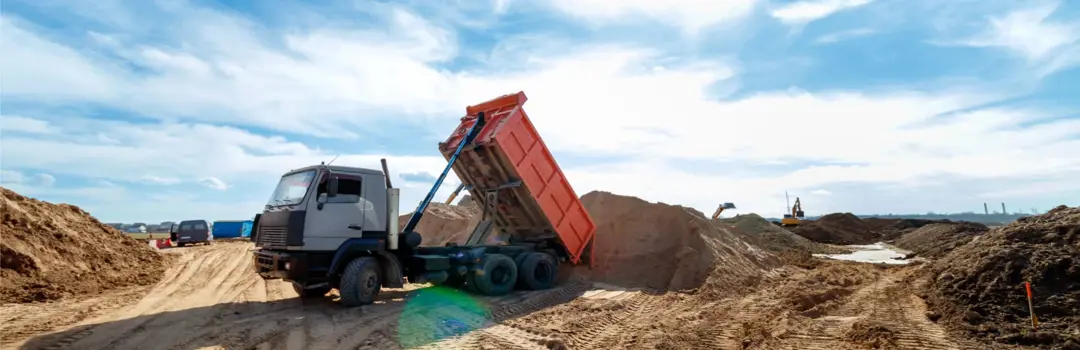
A dump truck reverses across a construction site to position itself under a loader. The driver checks his mirrors, shifts into reverse, and begins backing. Forty feet behind him, a laborer is crouching to take a measurement on the roadway. The driver can't see him. The laborer can't hear the alarm over the roar of a paving machine ten feet away. There is no spotter. There is no traffic plan separating trucks from workers on foot. The truck covers the distance in seconds.
While this might sound like an extreme example, scenarios like this one play out on worksites across the country, day after day, year after year. In fact, struck-by incidents are one of OSHA's "fatal four" (the top four causes of death in construction), and backing vehicles, dump trucks in particular, are responsible for a significant share of those fatalities. According to a Bureau of Labor Statistics (BLS) analysis of fatal injuries at road construction sites from 2003 to 2010, 84 workers were fatally struck by a backing dump truck. This equates to about one person killed per month. More recent data tells the same story: 809 construction and extraction workers were killed in dump truck-related incidents from 2011 through 2020. Mining, waste collection, and industrial operations add their own tolls on top of those numbers.
These deaths don't happen because workers aren't paying attention. They happen because the systems that should protect them, things like site designs, equipment, staffing decisions, and safety protocols, aren't in place. These deaths are preventable; they occur because employers, manufacturers, contractors, and others fail to do what they are supposed to do to keep workers safe.
What the Driver Actually Sees When a Dump Truck Reverses
To understand why these accidents keep happening, it’s important to first look at what a dump truck driver can and cannot see from the cab.
The operator of a typical dump truck sits high off the ground, facing forward. The truck body, a steel box that is designed to carry 20 or more tons of material, blocks the direct line of sight to everything behind it. Side mirrors help, but they only cover narrow strips along each flank of the vehicle and a partial wedge behind it. When the bed is raised, that limited rear visibility shrinks even more.
NIOSH's Construction Equipment Visibility program mapped the blind zones around 38 construction vehicles and 5 mining machines using standardized test procedures. For a standard three-axle dump truck, the findings are stark: a person must be at least 33 feet (roughly the size of a school bus) in front of the truck to be visible to the operator, and a person standing directly behind the truck cannot be seen at all. The entire area immediately behind the vehicle is a dead zone. There is no way to angle the mirrors, no way to turn one’s head, and no amount of experience that can overcome it.
It gets worse when you consider a worker’s posture. NIOSH developed blind-area diagrams at three heights:
- Ground level (i.e., laying or crouching down)
- 36 inches (about the height of a traffic barrel)
- 59 inches (slightly above average shoulder height)
When a worker crouches to pick up a tool, kneels to tie a boot, or leans over to shovel, they drop below that 59-inch plane and into a massive blind zone. Cameras and mirrors help, but they're not the fix a lot of people assume.
A rearview camera shows a narrow field, and its image is only useful if the driver is actively watching the screen at the moment a person enters the frame. In dusty, muddy, or wet conditions, that is, in typical conditions found at most construction sites, camera lenses degrade quickly. Mirrors distort distances and leave gaps between their fields of view. So, while this technology can help, it doesn’t eliminate the fundamental problem: from inside the cab of a dump truck, there is a large area in front of, behind, and around the vehicle where the driver simply cannot see.
The Safety Net That's Supposed to Exist
The hazard created by these blind zones is well understood, and an entire framework of safety measures exists to compensate for it. In theory, backing a dump truck on a worksite should involve multiple layers of protection working together:
When all of these layers are functioning, the system works. The problem is that on many worksites, most of these layers are missing, incomplete, or broken, and even one omitted element can lead to disaster.
When Backup Alarms Become Background Noise
We all recognize the standard "beep-beep-beep" tonal sound of a large vehicle backing up, and that’s because backup alarms have been a feature of heavy equipment for decades. They're one of the most recognized safety devices in construction and industrial work, but they're also far less effective than most people think.
On a busy construction site, ambient noise from paving machines, generators, compressors, and other heavy equipment routinely hit extremely high volumes, up to 100 decibels or more. A standard backup alarm might produce 97 to 112 decibels at the source, but sound drops off rapidly with distance, and the competing noise from everything else on site can swallow it entirely. A worker 50 feet behind a backing dump truck may not hear the alarm at all, or they may hear it but be unable to tell from which direction it's coming. This is because traditional tonal alarms produce a single-frequency "beep" that is inherently difficult to localize in noisy environments.
Then there's the problem of habituation. On a site with multiple dump trucks, excavators, loaders, and other equipment operating simultaneously, backup alarms are sounding nearly continuously throughout the workday. This beeping soon becomes background noise, rather than the warning it’s meant to be.
Researchers have documented this as a measurable neurological response: after repeated exposure to the same alarm tone, workers' physiological reaction to the sound genuinely diminishes. It’s like riding in an airplane and subconsciously tuning out the engine noise or failing to hear an air conditioner that’s been running for several hours. Only, with dump truck backup alarms, the consequences of tuning out the noise can be much more serious. Research shows that in roughly 88 percent of fatal dump truck backover incidents, the backup alarm was functioning at the time of the fatality.
When No One Is Watching the “No Zone”
If backup alarms can't reliably protect workers, the next layer of defense is a human one: a spotter. Also called a signaler or observer, a spotter is a designated person who positions themselves where they can see both the driver and the area behind the truck. They guide the driver using hand signals or radio communication. Critically, they also have the authority to stop the maneuver if anyone enters the “no zone,” or the area around the truck that the driver can’t see.
When properly implemented, spotters are one of the most effective ways to prevent backover fatalities. NIOSH's 2023 dump truck guidance is direct on this point: employers should "use a trained and dedicated spotter when backing a dump truck." The consensus standard ANSI/ASSP A10.47 describes what that looks like in practice: a worker with no other competing duties, in pre-established communication with the driver, positioned outside the vehicle's path, and empowered to halt the operation at any point.
On most worksites, the reality is much different.
After an accident, the investigation reveals the same breakdowns over and over: no spotter was assigned, or a spotter was pulled off to do other work, or the spotter lost visual contact with the driver, or the spotter was standing in the blind zone themselves. Sometimes the failure is even more basic: the spotter and driver did not have any agreed-upon hand signals or radio to communicate with each other.
One particular case from North Carolina illustrates how completely the spotter system can collapse. In October 2006, a 28-year-old laborer with two months on the job was working as a flagger on a residential resurfacing project. He had never received the state's required four-hour flagger training. A tack truck needed to back more than 1,000 feet to finish a strip of roadway, an enormous backing distance that the site layout made unavoidable. The driver warned workers to move, and one did. The flagger did not. He was standing on a manhole cover with his back to the truck. A dump truck driver 200 feet away saw what was happening and started waving his arms frantically. The tack truck backed 427 feet into the flagger. The driver felt the impact but thought he'd rolled over a manhole cover and continued another 25 feet before stopping.
There was no spotter. The backup alarm was working and audible from 30 feet. The flagger was wearing a reflective vest. It was the general contractor's fifth workplace fatality in 10 years, and its third backover fatality.
When Site Layouts Make Backing Up Unavoidable
Backup accidents aren’t just isolated events, tied to an individual truck or worker. A closer look reveals that many of these fatalities happen because the worksite itself was designed (or, more accurately, not designed at all), in a way that forces trucks to repeatedly reverse in close proximity to workers on foot.
On road construction projects, dump trucks often have to back hundreds of feet to reach a paving machine or material transfer point because the work zone doesn't include a turnaround. In plant yards and industrial sites, trucks reverse into loading bays, staging areas, and dump zones because the facility was laid out for material flow, not pedestrian safety. On many sites, dump trucks and foot traffic share the same space with no physical barriers, no designated walkways, and no controlled intersections.
The concept of an Internal Traffic Control Plan, or ITCP, has been part of NIOSH's guidance since 2001. The idea is straightforward: before work begins, map out where trucks will drive, where they'll load and dump, where workers will walk, and how those paths will be kept separate. The most effective ITCPs use one-way "drive-through" loops so trucks pull forward through loading and dumping areas rather than reversing into them. This eliminates most backing maneuvers entirely and, with them, the backover risk.
It's a well-known solution. NIOSH recommends it; the Federal Highway Administration has published guidance on it; trade organizations promote it. Yet a 2022 analysis of 75 NIOSH FACE work-zone fatality reports found that 55 percent of the investigated deaths were caused by equipment or vehicles inside the work zone, and more than a third of the reports documented no written safety program at all.
No traffic plan.
No designated routes.
No separation between trucks and people.
Every time a dump truck backs up on a worksite where workers are present, that backing maneuver exists because someone decided it would, or rather, because no one took the time to design it out. It’s not a driver’s failure or a worker’s mistake; it's a management decision.
When Every Safety Measure Fails
On January 29, 2002, a 34-year-old roadway construction worker in Virginia was walking alongside a road grader on a resurfacing project, picking up centerline lane reflectors. A dump truck loaded with asphalt was backing toward the paving machine. The driver was watching his mirrors. The worker was behind the truck, in the blind zone, moving in the same direction the truck was reversing. There was no spotter assigned to guide the truck. The site had no internal traffic control plan separating vehicles from workers on foot. The backup alarm was operating, but the worker was surrounded by the noise of multiple pieces of heavy equipment running simultaneously.
The truck backed over him.
He died at the scene.
The NIOSH investigation identified every failure point discussed in this article, all converging in a single event: a massive blind zone the driver couldn't overcome with mirrors alone, a backup alarm drowned out by ambient equipment noise, no spotter, and a site layout that put a truck's reversing path directly through an area where a worker was performing routine tasks on foot. Every one of the recommendations that came out of the investigation—use a spotter, implement an ITCP, separate vehicle paths from pedestrian areas, minimize backing distances—describes a measure that should have been in place before the work started, not after someone died.
Backup Safety Regulations Have Not Changed in Decades
The federal rules governing backup safety on worksites were written in 1971; in more than 50 years, there have been no significant changes to these rules.
OSHA's construction motor vehicle standard, 29 CFR 1926.601(b)(4), is the core rule. It states that no employer shall use a motor vehicle with an obstructed rear view unless the vehicle has a reverse signal alarm audible above the surrounding noise level or the vehicle is backed up only when an observer signals that it is safe. With that one word, “or,” the rule essentially treats a functioning beeper as legally equivalent to a trained, dedicated human being watching the blind zone and communicating with the driver in real time. More than five decades of research and fatality data have thoroughly dismantled that equivalence, but the regulation remains unchanged.
Outside of construction, the regulatory gaps are even wider. OSHA has no specific federal requirement for backup alarms in general industry at all. Workers in plant yards, warehouses, and industrial facilities are covered only by the General Duty Clause, the catch-all provision that requires employers to maintain workplaces free of recognized hazards. In mining, MSHA's rules are somewhat stricter, requiring backup alarms on essentially all surface mobile equipment, and the agency's 2023 Safety Program for Surface Mobile Equipment rule pushes operators toward written safety programs. However, the rule only applies to mines with six or more miners and doesn't mandate specific engineering controls, like proximity detection.
Perhaps the most glaring gap involves rear visibility technology. In 2014, the National Highway Traffic Safety Administration finalized a rule requiring rearview cameras on all new vehicles with a gross vehicle weight rating of 10,000 pounds or less. Every passenger car, SUV, and light truck sold since May 2018 has one. Dump trucks typically weigh 30,000 to 80,000 pounds when empty, meaning they are excluded from this rule. As a result, a minivan backing out of a suburban driveway has more federally mandated rear visibility technology than a loaded dump truck does, even when it is reversing across a construction site where dozens of workers are on foot.
The technology to prevent these deaths exists. Proximity detection systems, broadband alarms, camera systems, drive-through site layouts, all of these are widely available and proven to work. What doesn't exist is a federal requirement to use them. As a result, adoption of these life-saving technologies is inconsistent, uneven, and dependent on whether an individual employer decides that worker safety is worth the investment.
The Decisions That Put Workers in the Way of Danger
Workers who are injured or killed by backing dump trucks are not in the wrong place at the wrong time. They're in the place their employer sent them, at the time their employer scheduled them, doing the work their employer assigned. The truck is there because someone planned the site that way, or didn't really plan it at all. The spotter isn't there because someone decided not to assign one or pulled them off to do something else. The traffic plan doesn't exist because no one wrote it.
These are employer decisions, every one of them.
When those decisions lead to a worker's death, the investigation almost always produces the same short list of recommendations: assign a dedicated spotter, write and enforce a traffic control plan, install cameras or proximity detection, redesign the site to minimize backing. These are not novel ideas. They appear in NIOSH guidance dating back to 2001. They show up in FACE reports from the early 1990s. They are printed on laminated cards, posted in break trailers, and discussed at toolbox talks.
And yet a 2025 analysis of OSHA dump truck inspection data found that only about half of dump truck worker fatalities resulted in a serious OSHA violation. Three-quarters of nonfatal injuries resulted in an "other" violation or no violation at all. The message this sends to the industry is unmistakable: the cost of killing a worker behind a dump truck is, more often than not, negligible. That is unacceptable.
The absence of an OSHA citation does not bar a worker or their family from bringing a civil suit. Workers are not expendable inputs in a production equation. They are people with families, with lives outside of work, with every right to go home at the end of a shift. When employers fail to implement the basic, well-known measures that prevent backover fatalities, they are making a choice. And when that choice results in a worker's death, they must be held accountable. No exceptions.
Arnold & Itkin represents workers and families who have been affected by preventable workplace accidents, including those involving heavy equipment on construction sites, in industrial facilities, and across high-risk industries. The firm’s industrial accident attorneys have taken on cases where employer negligence, inadequate safety protocols, and failures in worksite management led to serious injuries and deaths. With more than $25 billion recovered through verdicts and settlements, Arnold & Itkin has the trial experience and resources to hold negligent employers accountable when the systems meant to protect workers fail. The firm handles cases across Texas and nationwide.
- Categories