Tanker Truck Falls Are Still Killing Workers
As he had done countless times in the past three years, a truck driver pulled up to the elevated catwalk area of a cement plant and stopped his tanker trailer exactly where he was supposed to. He needed to close the lid to the tank, which was at the top, and the gangway that lowered from the catwalk would give him direct access to the lid. A straightforward task, one that this 57-year-old had accomplished plenty of times.
However, once he’d crossed the catwalk and reached the gangway, the gangway didn’t reach far down enough; it left a gap of about 30 inches from the bottom of the guardrail and the top of the tank trailer. Even though this truck driver worked for a national company, they hadn’t equipped him with a safety harness or lifeline. When the driver tried to close the lid, he slipped through the gap between the guardrail and the tank trailer and fell 12 feet to the ground below.
It wasn’t until a security guard realized that the tanker hadn’t moved on, and he went to investigate, that he saw the driver on the ground, motionless with blood pooling around his head. The driver would be pronounced dead from blunt force trauma at the hospital.
The tragedy was investigated by the California Fatality Assessment and Control Evaluation (CA/FACE) Program. The investigator noted that this company, which employs thousands of drivers across the country, did not include fall protections in its written safety procedures for using catwalks. This particular catwalk was also found to be faulty, as it wouldn’t adjust to every size of tank trailer, another glaring lapse in safety measures.
This was in 2008, and preventable, often deadly fall accidents like this incident still occur with alarming regularity. These fall accidents may not be the most obvious risk that can beset workers in the trucking industry, and they don’t grab headlines the way that truck crashes and spills do. But fall risks can quickly turn even the more mundane tasks, from load transfers to cleaning, into life-changing or even fatal accidents.
Why Workers Need to Access the Top of a Tanker
Most of the safety attention in the trucking industry focuses on what happens when vehicles are on the road: collisions, rollovers, brake failures, and such. The hazards of driving are visible and understood. But a substantial portion of the work that surrounds tanker operations happens when the truck is stopped, and some of the most dangerous of those tasks happens 7 to 12 feet off the ground.
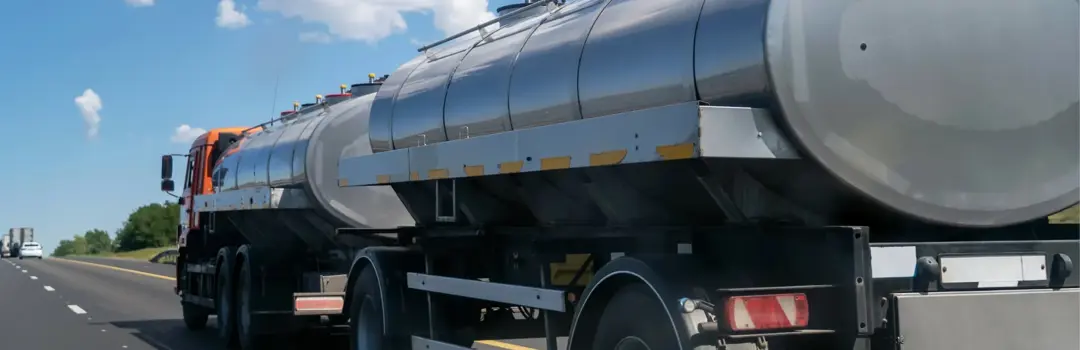
A tanker truck is designed to move cargo, not to be worked on top of. Yet every load requires a series of tasks that can only be performed from the top of the tank. Fuel tankers require workers to connect and disconnect overhead loading arms at petroleum terminals. Milk and food-grade liquid tankers require sampling and temperature verification before product can be accepted at processing facilities. Chemical tankers require hose connections and valve checks that must be performed above. Pneumatic tankers (the kind with conical metal cylinders that carry cement sand, fly ash, and similar dry bulk materials) require workers to access dome hatches to initiate and complete transfers. Tank cleaning, which follows load changes in food and chemical transport, requires workers to reach open hatches and risk work in enclosed, confined spaces.
Workers in these industries perform them daily, in all kinds of weather, at facilities with inconsistent infrastructure.
What Workers Are Standing On
A tanker’s profile might look manageable from the ground: a cylindrical vessel, maybe 13 feet at its highest point, sitting on a truck chassis. But the geometry of that cylinder (and its variations) is exactly what makes it hazardous to stand on or near.
Many tankers are almost entirely cylindrical, providing a walking-working surface that is inherently unsafe, demanding that safety measures be taken. While some tanker trailers have a level area on top of their cylindrical tanks, the rest of the surrounding surface is sloping away from workers in every direction.
Additionally, petroleum residue, milk, chemical condensate, wet cement dust, or other substances can cling to tank surfaces without being clearly obvious: a surface that looks clean can be slick with the film left by the last load. Dome hatches, inspection ports, and gauging tubes protrude from the tank as well, creating uneven terrain.
How a Fall from a Tanker Happens
Workers fall because they’re working, reaching, pulling, or simply climbing a ladder, too often without the personal fall protection or fall arrest systems they need.
Workers require anti-slip tape, guardrails, safety harnesses and lines, and other protections in order to counteract the inherently treacherous surface of the top of a tanker. These safety measures can vary from facility to facility, however, as drivers travel from smaller operations to older facilities and high-turnover environments. For instance, a driver hauling milk to six different sites in a shift may encounter six different catwalk configurations.
For drivers who work independently or for smaller carriers, the expectation may be of self-sufficiency at the top of a tank. Climbing the tank is simply what you do. While training may have covered hours of service and safe driving habits, fall protection may never have been addressed.
The incidents documented here show how routine these falls can be. The surface of a tanker truck was simply not designed to support workers moving safely; protections must be added in.
Tanker Falls: A Recent Timeline
Select any incident to see full details and citation record.
Why a Short Fall Kills
Twelve feet might not sound like much; that’s roughly the height of a one-story ceiling. But a fall from 12 feet onto a concrete loading pad or steel-surfaced terminal apron is a high-energy event. Without any deceleration, no net, no lanyard, no yield surface, a falling body strikes the ground with thousands of pounds of force (more than 2,000 pound-force ft, or more than 3,000 joules). The impact can be absorbed entirely by whichever part of the body contacts the surface first.
At tanker truck operations, the landing surfaces are almost uniformly unforgiving: gravel lots, metal terminal floors, concrete truck pads, etc.
What Fall Prevention Looks Like
OSHA’s mandates that employers provide fall protection systems to ensure that workers have safe surfaces on which to perform their jobs. These standards clearly state that when an employee needs to work on a surface that is 4 feet or higher above the next level down, workers must be provided with guardrails, safety nets, and/or a personal fall protection system. When there are holes above a 4-foot drop or more, there likewise must be covers, guardrails, travel restraint systems, and/or personal fall arrest systems.
Personal fall protection systems include body belts, harnesses, and other fall arrest and travel restraint systems. These lanyards and lifelines must limit free-fall distance, hold up thousands of pounds even when fully taut, and the different components, like carabiners, must be able to hold up under 5,000-pound loads. Depending on the specifics of a platform and the job, OSHA specifies the durability, stability, strength, and dimensions for various safety systems, whether for ladders, guardrails, etc.
One way of organizing these protective measures is the hierarchy of controls, a framework provided by the CDC’s National Institute for Occupational Safety and Health (NIOSH).
The first and most effective control is elimination. So first, can the task be redesigned so that fall hazards are removed? Closed loop loading is a configuration that allows for tanks to be filled from the bottom, so that a worker can stay on the ground. Similarly, side-truck sampling systems allow workers to stay on the ground, getting rid of the need for workers to access the top of a tanker in order to test materials. Automated loading and unloading is when a machine system can substitute for a worker being on the top, using cameras and other technology to sense and access the tanks hatches itself, taking over this hazardous part of the job.
A substitution control could include closed-sampling systems that prevent fluids or vapors from escaping into the environment, and from making the tank slick and more treacherous for workers. While these methods don’t eliminate the fall hazards, they can reduce the level of risk involved. Substitution would involve replacing a hazardous method with one that is at least safer, if not completely hazard-free.
Engineering controls are next. This would include fixed gangway platforms with self-closing gates, full-perimeter guardrails, and fall arrest anchor points that meet OSHA specifications. These build protections to keep workers physically separated from fall hazards.
Administrative controls can include ensuring only workers who have been fully trained on how to perform specific jobs atop tanker trucks should be allowed the access to perform those jobs. It would also mean having comprehensive safety plans in writing, plans that workers are fully trained on.
Finally, personal protective equipment (PPE) finishes out this hierarchy. Personal fall arrest equipment, such as harnesses and lanyards, sits lower in the hierarchy because it provides last-resort protection, if all else fails.
Hierarchy of Controls: Tanker Fall Hazards
Ranked from most to least effective. Controls at the top remove the hazard entirely; those at the bottom depend on individual behavior.
Source: NIOSH Hierarchy of Controls · Applied to tanker fall hazards per 29 CFR 1910.28–1910.29
Safety controls like adjustable gangway systems that accommodate multiple tank heights are commercially available. Automated loading and unloading technology can take away fall risks from workers entirely. The engineering knowledge exists, and the equipment and technology exist. The regulatory requirement has existed for decades.
The difference between those facilities and the ones in the timeline isn’t technical. It’s what was decided by the employers responsible for worker safety. Were employers willing to invest in the technology that could eliminate fall hazards for their workers? Were they at least thorough in training workers on safe procedures and using personal protective equipment?
While some protection measures are more reliable than others, employers owe their employees a workplace that is free from known and potentially catastrophic hazards. That includes ensuring that workers enjoy a workplace free from fall hazards.
Even at High-Risk Jobs, Employers Are Ultimately Responsible for Worker Safety
In cases where OSHA cites employers for serious violations, accidents like these are still often framed in terms of individual action. A worker lost their footing. A worker stepped backwards. These descriptions are technically accurate in describing the moment of injury, but not the failures that created conditions for it.
The hazardous nature of this work does not reduce an employer’s responsibility; it increases it. When the risks of a job are well understood, well-documented, and already addressed by federal regulations, an employer cannot point to the difficulty of the work as an explanation for why protection was absent, or why disaster struck. Tanker falls are a known hazard. The fall protection standards that apply to them have been on the books for decades. Employers in this industry are not discovering these risks for the first time. That knowledge carries an obligation, and when workers are injured or killed because that obligation was not met, the cause is not the job itself, but it is the employers who failed to value worker safety.
When workers fall from tanker trucks and loading racks, the circumstances that follow tend to reveal the same pattern: a standard requiring fall protection, infrastructure that was never installed, and employers who treated the climb as part of the job rather than a hazard to engineer around. Arnold & Itkin represents workers and families in exactly these situations. The firm’s attorneys who handle work injury and death cases have recovered verdicts and settlements against carriers, facility operators, and major employers across the country, contributing to a firm record of more than $25 billion recovered on behalf of clients. Arnold & Itkin is based in Houston and takes cases throughout Texas, Louisiana, New Mexico, and nationwide.