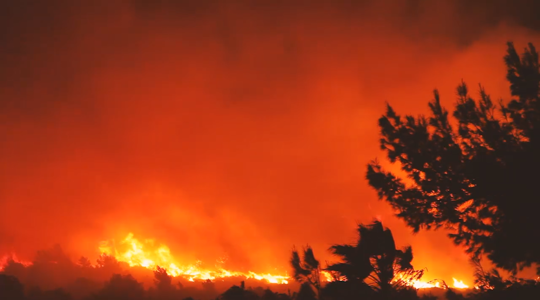
What Are My Two Claims After a Wildfire?
Most people know about the insurance claim. Fewer know about the second one, and the second one is often where the money for a total loss has to come from.
A first-party claim against your own insurer. This is the claim under your homeowners, commercial property, or business interruption policy. You are owed the structure, the contents, additional living expenses while you are displaced, and lost income if a business was hit. After a mass-loss event, carriers slow down, dispute scope, and undervalue contents. Some cancel or non-renew fire coverage in high-risk areas shortly before fires arrive. We saw the same playbook after Hurricane Harvey, and we have been beating it ever since.
A third-party claim against whoever caused the fire. Wildfires are not all acts of God. Many start because a company did not maintain its equipment, did not clear vegetation around its power lines, did not de-energize in dangerous wind, or ignored basic safety rules on its own property. If negligence caused or spread the fire, that company can be held liable for what it destroyed. Utility-caused wildfire litigation has produced some of the largest recoveries in American history.
Why the Second Claim Matters
Your policy has a ceiling. A negligence claim does not.
Your Insurance Claim Alone
Capped at your policy limits. Depreciated values on contents. Living expenses that run out on a schedule. Nothing for the years of your life the fire took.
Adding a Negligence Claim
Full cost to rebuild rather than depreciated value. Business destruction and lost profits. Injuries and wrongful death. Emotional distress. No policy ceiling.
Who Can Be Held Responsible for a Wildfire?
Cause is an engineering and investigative question, and it is usually resolved by fire investigators, forest service agencies, and the companies’ own filings long before any trial. Depending on the fire, responsibility can fall on several parties at once.
Who Can Be Held Responsible
After a wildfire, responsibility rarely sits with a single company.
Electric utilities
Transmission and distribution equipment, pole inspection programs, and the decision whether to cut power in red flag conditions.
Line and vegetation contractors
Companies hired to inspect equipment or clear brush and limbs away from energized conductors, and the records showing what they actually did.
Equipment manufacturers
Defective conductors, hardware, insulators, and other electrical components can support a
product liability claim alongside the negligence case.
Railroads
Equipment and maintenance failures can throw sparks into dry grass or brush. Poorly maintained right-of-way vegetation can increase fire risks.
Landowners, operators, and contractors
Hazardous conditions left in place, burn restrictions ignored, or hot work performed in dangerous weather by industrial, construction, or campground operators.
Government entities
Land management failures can support a claim, but these are subject to separate immunities and notice deadlines that are far shorter than ordinary claims.
The cause of an actively burning fire is almost never known early on. What matters early is that evidence gets preserved. The pole, the conductor, the maintenance records, the inspection history, and the weather data all matter, and some of it disappears quickly.
Why Do Utility-Caused Wildfires Keep Happening?
The pattern repeats across investigations, and each failure leaves a record we can subpoena.
- Inspection cycles get stretched. When budgets tighten, inspection intervals grow. Wooden poles installed decades ago rot from the inside, and a pole that fails in high wind puts an energized line on the ground.
- Vegetation work gets deferred. Clearing trees and brush away from lines is expensive and continuous, which makes it easy to postpone. Contact between vegetation and an energized conductor is one of the most common ignition sources in the country.
- Power stays on in dangerous weather. Utility companies know which conditions turn a downed line into a catastrophe. Shutting off power costs revenue and generates complaints. Choosing not to shut off power during a red flag warning is a decision, and decisions leave a paper trail.
- Known high-risk circuits go unhardened. Covered conductors, fault detection, and adjusted reclosing settings can prevent exactly this. When a company identified a circuit as high risk and spent the money elsewhere, that record becomes central to the case.
What Can a Wildfire Claim Recover?
Recoverable losses depend on the claim and the state, and they usually reach well past the structure itself. They include the full cost to rebuild or replace real property rather than depreciated value, contents and vehicles, business destruction and lost profits, evacuation and displacement costs, loss of trees, timber, crops, and livestock, smoke inhalation and respiratory injury, burn injuries, wrongful death, emotional distress, and remediation of smoke, soot, and ash contamination that insurers routinely underpay.
What If My Insurer Is the Problem?
Delay, denial, and underpayment after a catastrophe are not accidents. They are a business practice, and in most states they are actionable.
Watch for a carrier that will not commit to a coverage position, that keeps requesting documents you already sent, that reassigns adjusters repeatedly, that values contents at a fraction of replacement cost, or that pays for a restoration job so inadequate you can still smell smoke in the walls. Your carrier owes you a good-faith investigation and payment within statutory deadlines.
Learn more about bad-faith insurance, first-party claims, and property damage claims.
What Should I Do After a Wildfire Loss?
The first days shape the case. Document everything before anyone cleans up, and do not let a carrier or a company representative put words in your mouth while you are still displaced.
Protect Your Claim While You Recover
The insurer and the utility both started building their files immediately. Start building yours.
1
Document everything before cleanup.
Photograph and video the structure, the contents, the vehicles, and the land. Room by room if anything is left standing.
2
Keep every receipt related to the fire and its aftermath.
Lodging, meals, fuel, clothing, tools, and supplies. Living expenses are recoverable, and carriers pay only what you can prove.
3
Do not sign what you do not understand.
Releases, scope-of-work documents, and proof-of-loss forms can limit what you recover later. Have them reviewed first.
4
Do not give a recorded statement yet.
Talk to a lawyer before any recorded interview with an insurer or a company representative.
5
Preserve the evidence on your property.
Do not let anyone haul away debris, poles, or equipment before it has been documented. It may prove how the fire started.
Why Do Wildfire Victims Choose Arnold & Itkin?
A utility facing wildfire liability hires the best defense firms in the country and spends whatever it takes. An insurer facing thousands of claims knows how much pressure the average claimant can absorb before accepting less than they need. Neither is moved by a demand letter from a firm that does not try cases.
We are a trial firm. Our attorneys have spent more time trying cases than many lawyers spend in an entire career. We fund our cases fully and put investigators and engineering experts on the ground early. We do not need a defendant’s permission to put a case in front of a jury. We have recovered more than $25 billion for our clients, including some of the largest verdicts in United States history. See all of our victories.
Lost Everything in a Wildfire? Talk to Us Before You Talk to the Insurer.
You should not have to become an expert in policy language and utility engineering while you are trying to find somewhere for your family to sleep. That is our job. Call Arnold & Itkin at (888) 493-1629 or contact us online for a free, confidential consultation. We never stop fighting. No Matter What.