Can I Sue a Utility for a Texas Wildfire?
Yes, and it has already happened at scale in this state: the Smokehouse Creek Fire.
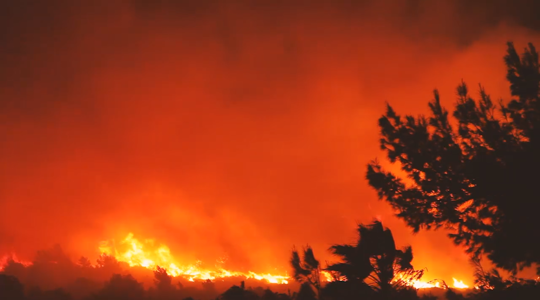
On February 26, 2024, fires broke out across the Texas Panhandle. The Smokehouse Creek Fire Complex burned approximately 1,055,000 acres, making it the largest wildfire in Texas history. The Texas A&M Forest Service issued incident reports finding that the Smokehouse Creek Fire and the 687 Reamer Fire, which burned into its perimeter, were caused by power lines owned by Southwestern Public Service Company, a subsidiary of Xcel Energy, after wooden distribution poles near each origin point failed.
The Smokehouse Creek Fire: What Happened
About 1,055,000 acres burn (February 26-29, 2024)
Fires break out across the Texas Panhandle. The complex becomes the largest wildfire in state history. The Attorney General’s office attributes three deaths and more than $1 billion in damages to the fire.
Investigators identify the cause (March 2024)
Texas A&M Forest Service reports attribute the fire to a utility power line after a decayed wooden pole failed near the origin point.
The State sues (December 2025)
The company agrees to replace poles (February 2026)
The parties jointly file a
temporary injunction under which the utility agrees to specified distribution pole replacement procedures.
About $404 million in settlements reached (June 2026)
Company
securities filings report roughly $404 million in expected loss payments, of which about $398 million had been paid as of June 30, 2026. Those settlements include fatality claims, subrogated insurers, and the largest acreage-based claims.
Sources: Texas A&M Forest Service incident reports; Office of the Texas Attorney General; Xcel Energy Form 8-K, Q2 2026.
That record matters to anyone who lost property in a Texas fire caused by electrical equipment. The liability theory works, the causation evidence exists, and utilities operating in this state have already paid hundreds of millions of dollars rather than try these cases. It also means the next one will be defended harder.
How Do You Prove a Power Line Started the Fire?
The failures behind these cases are documented and provable. Rotted or under-inspected wooden poles. Vegetation allowed to grow into energized conductors. Lines left energized through red flag conditions. Circuits a company already identified as high risk and left unhardened while capital went elsewhere.
The proof lives in inspection records, maintenance schedules, internal risk assessments, weather data, and the physical hardware at the origin point. Building that case requires investigators and engineering experts on the ground early, and it requires a firm willing to fund that work before anyone has been paid a dollar. We do.
What If My Insurance Company Is the Problem?
For most Texans, the first fight is with their carrier, not a utility. Texas law gives you real leverage there. Under the Texas Prompt Payment of Claims Act, insurers must acknowledge, investigate, and pay claims within statutory deadlines, and a carrier that violates them can owe interest and attorney’s fees on top of the claim. Bad-faith conduct carries its own exposure. That includes an unreasonable investigation, a denial without a reasonable basis, or a lowball offer designed to exploit desperation.
After a mass-loss event, carriers get slower and stingier at exactly the moment policyholders can least afford it. Contents get valued at a fraction of replacement cost. Smoke and soot remediation gets scoped as a cleaning job when the damage is structural. Additional living expenses get cut off while families are still displaced.
You have rights. Learn more about Texas fire and smoke damage claims and business interruption claims and how they may influence your case as a property owner.
What Can I Recover for a Ranch or Farm Loss?
In the Panhandle and across West Texas, the loss is usually not just a house. It is the operation. Adjusters routinely value pasture and livestock at numbers that bear no relationship to what it costs to rebuild a working ranch.
A Ranch Loss Is More Than a Property Loss
What standard policies miss, and what a negligence claim can cover.
Infrastructure
Fencing by the mile, outbuildings, corrals, irrigation systems, water wells, and equipment.
Livestock
Herds lost outright, animals injured badly enough that they have to be destroyed, and the breeding value that goes with them.
Land and forage
Grazing land out of rotation for seasons, destroyed hay stores, timber, and soil damage that takes years to recover.
Lost production
The years of income the operation would have produced while the land comes back. This is usually the largest number in the case.
How we prove it
Agronomists, range scientists, livestock valuation experts, and forensic accountants. We build agricultural loss claims that way because adjusters will not.
What Should I Do After a Texas Wildfire?
The first days shape the case. The insurer and the utility both started building their files immediately.
Protect Your Claim While You Recover
Five things to do before you talk to an adjuster.
1
Document everything before cleanup.
Photograph and video the structures, contents, equipment, fencing, and livestock losses. Get aerial images of burned acreage if you can.
2
Report the claim in writing.
Texas policies carry prompt-notice requirements. Notify your carrier in writing and keep a copy with the date.
3
Keep every receipt.
Lodging, feed, fuel, temporary fencing, equipment rental, and labor. Carriers pay only what you can prove.
4
Do not sign or record anything yet.
No releases, no scope-of-work documents, and no recorded statements to an insurer or a utility representative before you speak with an attorney about your options and rights.
5
Preserve the evidence on your land.
Do not let anyone remove poles, conductors, hardware, or debris before it is documented. That material can prove how the fire started.
Wildfire Death Claims in Texas
Wildfires kill and maim. This includes firefighters, ranchers defending their land, families caught while evacuating, and people who suffer serious respiratory injury from smoke without ever being touched by flame. Burn injuries require years of surgery and rehabilitation, and the cost of that care is central to the case. If your family lost someone in a Texas wildfire, you may have a wrongful death claim against the party responsible. Texas generally imposes a two-year deadline, and claims against governmental entities require notice much sooner. Do not assume you have time.
Lost Property in a Texas Wildfire? Call Before You Talk to an Adjuster.
The insurance company and the utility both started working your file right away. Call Arnold & Itkin at (888) 493-1629 or contact us online for a free consultation with a Texas wildfire lawyer. We never stop fighting. No Matter What.