What a Plant Has to Know Before It Accepts a Load
Every facility that treats, stores, or disposes of hazardous waste must have a permit under the Resource Conservation and Recovery Act, the federal law known as RCRA. The permit comes with rules about knowing what is on site.
Before a plant treats or stores a waste, federal rules require it to obtain a "detailed chemical and physical analysis of a representative sample." It has to keep that analysis up to date, follow a written waste analysis plan, and check each shipment it receives against the shipping paperwork.
The company that created the waste has its own duty. A generator "must make an accurate determination" of whether its waste is hazardous, and the manifest that travels with each shipment records the type and quantity of waste and how to handle it. A waste plant's workers rely on both companies to get this right.
How Hazardous Waste Facility Explosions Happen
Federal investigators and regulators have carefully investigated past hazardous waste plant explosions. Their findings point to a handful of failures.
Wastes That Reacted with Each Other
Federal rules require a waste plant to "take precautions to prevent accidental ignition or reaction" of ignitable and reactive wastes and to keep incompatible wastes apart. On August 31, 2020, the EPA and the State of Nebraska announced a settlement with the operator of a commercial hazardous waste incinerator in Kimball, NE. The agencies alleged the company "failed to address multiple fire incidents resulting from the company's mixing of incompatible wastes." The company agreed to a $790,000 civil penalty and an updated fire prevention and response program.
A Load That Wasn't What the Plant Expected
On November 17, 2018, an explosion at the US Ecology hazardous waste site in Grand View, ID killed a worker. The EPA's response record says the blast was in a building used to process magnesium waste. An investigation commissioned by the company blamed a reaction between water, magnesium, and "non-conforming materials," and the company's chief executive said the site had received a shipment containing material that was not supposed to be in the approved waste stream, KIVI reported in August 2019.
Flammable Vapor That Reached an Ignition Source
Solvents and fuels give off vapor, and waste plants handle both in bulk. Shortly after midnight on May 4, 2009, flammable vapor escaped from a solvent recovery unit at the Veolia ES Technical Solutions plant in West Carrollton, OH, drifted into a building, and ignited. Two workers were seriously injured. The U.S. Chemical Safety Board found that boilers in the building were the most likely ignition source and that the building stood less than 30 feet from the process units. The Board's chairman said, "This accident should not have happened."
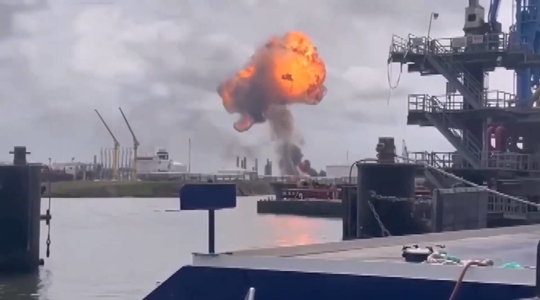
On November 17, 2026, a treatment vessel exploded at Clean Harbors' Deer Park hazardous waste facility in La Porte, TX, sending one worker to the hospital. The Harris County Fire Marshal's Office said hydrocarbon vapors ignited inside the vessel and that it had found evidence of two minor fires in the same process during the week before, KPRC reported. On November 18, 2026, the office said it was still evaluating the conditions that allowed the ignition.
Failures in the Incinerator Itself
On July 13, 2013, an explosion ruptured ducting at the Heritage Thermal Services hazardous waste incinerator in East Liverpool, OH and sent untreated flue gas, steam, and boiler ash beyond the fence line. When the Justice Department and EPA settled with the company in October 2018, they called the release "a consequence of systemic failures to comply with the Clean Air Act."
No Alarms, No Sprinklers & Nobody on Site
On the night of October 5, 2006, a fire started in a storage bay of the EQ hazardous waste facility in Apex, NC and spread to bays holding flammable and corrosive wastes. The plant was unstaffed. The Chemical Safety Board's final report found the building had no fire or smoke detection, no automatic sprinklers, and no fire walls between bays, and that the company had not given the fire department written information about what was stored there. The facility was destroyed. In the same report, the Board said it had found 21 other fire and chemical release incidents at U.S. hazardous waste facilities in the previous five years.
What These Incidents Do to Workers & Neighborhoods
For the people inside the fence, a waste plant explosion means burns, blast injuries, and lungs damaged by smoke and chemical vapor. But the harm often crosses the property line. The West Carrollton explosion damaged about 20 homes and 5 businesses. In Apex, the evacuation area covered about 3,300 residences, and about 30 people, including first responders, were evaluated at hospitals. On January 2, 2005, explosions and fires at a hazardous waste incineration facility in El Dorado, Arkansas, forced about 2,600 people from their homes, according to EPA's response record, and officials had to let the fire burn out because the drums might hold material that reacts with water.
If you live near an industrial plant and breathed smoke or fumes after a fire or chemical release, see a doctor and tell them what was reported to be burning. Keep photos of any damage to your home. Don't wait to talk to an attorney about your legal rights and options.
Who Regulates Hazardous Waste Plants?
The EPA writes the RCRA rules, and states carry most of them out. In Texas, the Texas Commission on Environmental Quality issues industrial and hazardous waste permits. Each permitted plant must train its workers, keep a contingency plan for fires, explosions, and releases, and have an emergency coordinator on site or on call at all times.
OSHA protects the workers. Its hazardous waste operations standard, known as HAZWOPER, applies to treatment, storage, and disposal facilities and requires safety, training, medical surveillance, and emergency response programs. A plant that holds 10,000 pounds or more of flammable liquid or gas in a process can also fall under OSHA's process safety management standard. OSHA cited the West Carrollton plant under that standard after the 2009 explosion.
The Chemical Safety Board investigates major chemical incidents. It "does not issue fines or citations," but its reports often give the clearest account of what failed.
Who Can Be Held Responsible for a Hazardous Waste Facility Explosion
A regulator's fine goes to the government. It does nothing for the worker in the burn unit or the family whose house was damaged. A civil claim is how the people who were hurt hold a company to account, and in a hazardous waste facility explosion there is often more than one company to look at.
Depending on the circumstances, the following parties may be liable:
- The plant's operator decides what waste to accept, how it is sampled, where it is stored, and what it is mixed with. It is responsible for the fire protection, training, and condition of the equipment. When an operator skips the analysis, stores incompatible wastes together, or keeps a unit running after warning signs, it puts production ahead of the people on its site.
- The company that shipped the waste can be responsible too. If a generator mislabels a load or leaves out what the plant needed to know, the workers who open that container are the ones who pay for it.
- Contractors, equipment makers, and transporters round out the list. A contractor may have done the maintenance or hot work that set off the fire. A manufacturer may have built the vessel, valve, or safety system that failed.
In most states, workers' compensation limits what you can recover from your own employer. It does not protect the other companies involved, and many plant workers are employed by a contractor rather than the plant's owner. Sorting out who employed you and who controlled the work is one of the first things we do. Neighbors with injuries or property damage aren't limited by workers' compensation at all.
Talk to Our Hazardous Waste Facility Explosion Lawyers
Our firm has spent more than two decades helping people hurt in plant and refinery accidents and chemical plant explosions in Texas, Louisiana, and across the country. Waste companies and their insurers start protecting themselves the night of the incident. We move just as fast to preserve manifests, waste profiles, sampling records, and maintenance files that show what the company knew, and we take cases to trial when a company won't accept responsibility.
If you or someone you love was hurt in an explosion, fire, or chemical release at a hazardous waste facility, call (888) 493-1629. Your consultation is free; you pay nothing unless we win.